


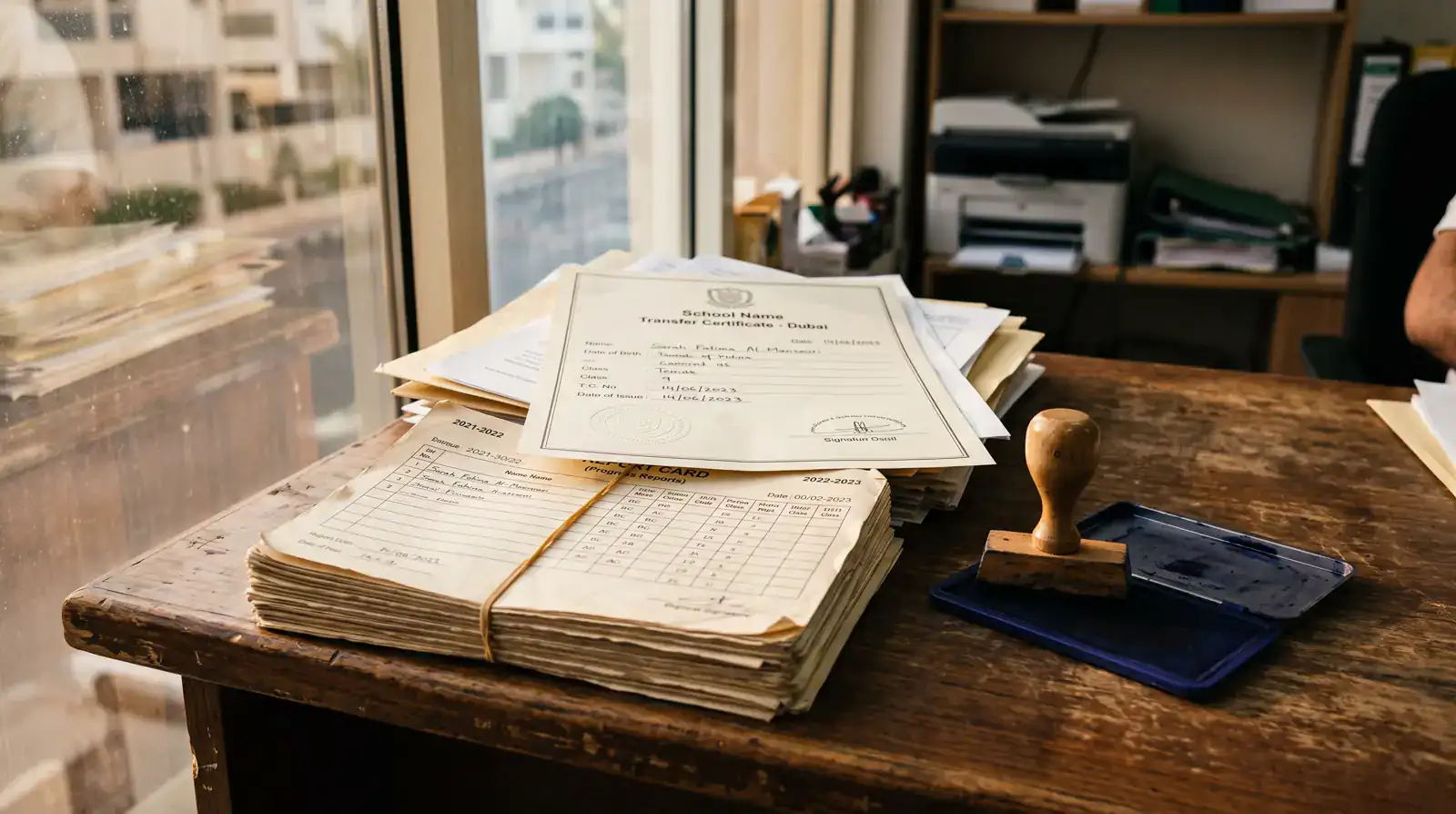
A school place in Dubai is not secured by an offer letter. It is secured by a piece of paper the previous school controls.
That is the whole problem in one sentence, and it explains why every August our desk fills with parents who have an accepted application, a paid deposit and no transfer certificate.
The wider list of what a Dubai school wants at enrolment is on school admission documents in Dubai. This page is the one document on that list that another institution has to hand over, and that a government chain may have to stamp.
What a transfer certificate actually is
Called a TC, a leaving certificate or a school leaving certificate, depending on who is talking.
It is the outgoing school's formal statement that the child was enrolled, which grade they completed, and that they have left. KHDA's own guidance treats it as the reference a receiving school uses to place a child correctly, and it is required for registration at another private school or educational institution in Dubai and across the UAE.
It is not a report card. It is not a reference letter. Schools issue all three and parents routinely bring the wrong one.
| Document | What it proves | Does the new school need it? |
|---|---|---|
| Transfer certificate | Enrolment, grade completed, and formal release | Yes, for Grade 1 / Year 2 and above |
| Report card | Academic performance in a term or year | Usually yes, alongside the TC, not instead of it |
| Reference or recommendation letter | A teacher's opinion | Sometimes requested, never a substitute |
| Attested birth certificate | Identity and date of birth | Yes, separately from all of the above |
When you need one, and when you do not
The threshold is grade, not age.
KHDA guidance points at Grade 1, or Year 2 in a British-curriculum school, as the point from which the transfer certificate becomes the primary placement reference. Below that, at nursery and early years, the requirement is lighter, though early childhood centres do expect transfer certificates for children moving between settings.
Moving within Dubai, between two KHDA-regulated private schools, is the simplest version. The certificate is a UAE school document and the receiving school reads it directly.
Moving into Dubai from another country is the version that costs weeks, because now a foreign institution issued the paper and a chain has to vouch for it.
The fee clause that stops everything
Here is the clause that ends more September starts than any curriculum mismatch.
A school is entitled to withhold the transfer certificate until all outstanding fees are paid in full. If the fees are not settled, the certificate is not issued.
Read that as an operational fact rather than a dispute to win. The receiving school will not register without the certificate. The releasing school will not issue without payment. There is no third door, and arguing about whether a term's fees were fairly charged does not move a child into a classroom in September.
Does it need attestation? It depends on where it came from
KHDA's position is that attestation requirements depend on the country that issued the certificate. That is genuinely the rule, and it is why you get five different answers from five different parents.
The practical split:
| Where the certificate was issued | Attestation typically needed | Realistic timeline |
|---|---|---|
| A Dubai private school (KHDA-regulated) | No external chain. The school issues it, the new school reads it | Days |
| Another UAE emirate | Usually none, though the receiving school may ask for the local education authority stamp | Days |
| A school abroad | Yes. Issuing-country chain, then the UAE embassy there, then MOFAIC here | Three to six weeks, often longer |
| A school abroad, certificate not in Arabic or English | As above, plus a legal translation | Add a week |
Ask the receiving school in writing what they require for your specific country. Not a phone call. An email you can forward to whoever runs the chain, because "the school said it was fine" is not something an attestation counter accepts.
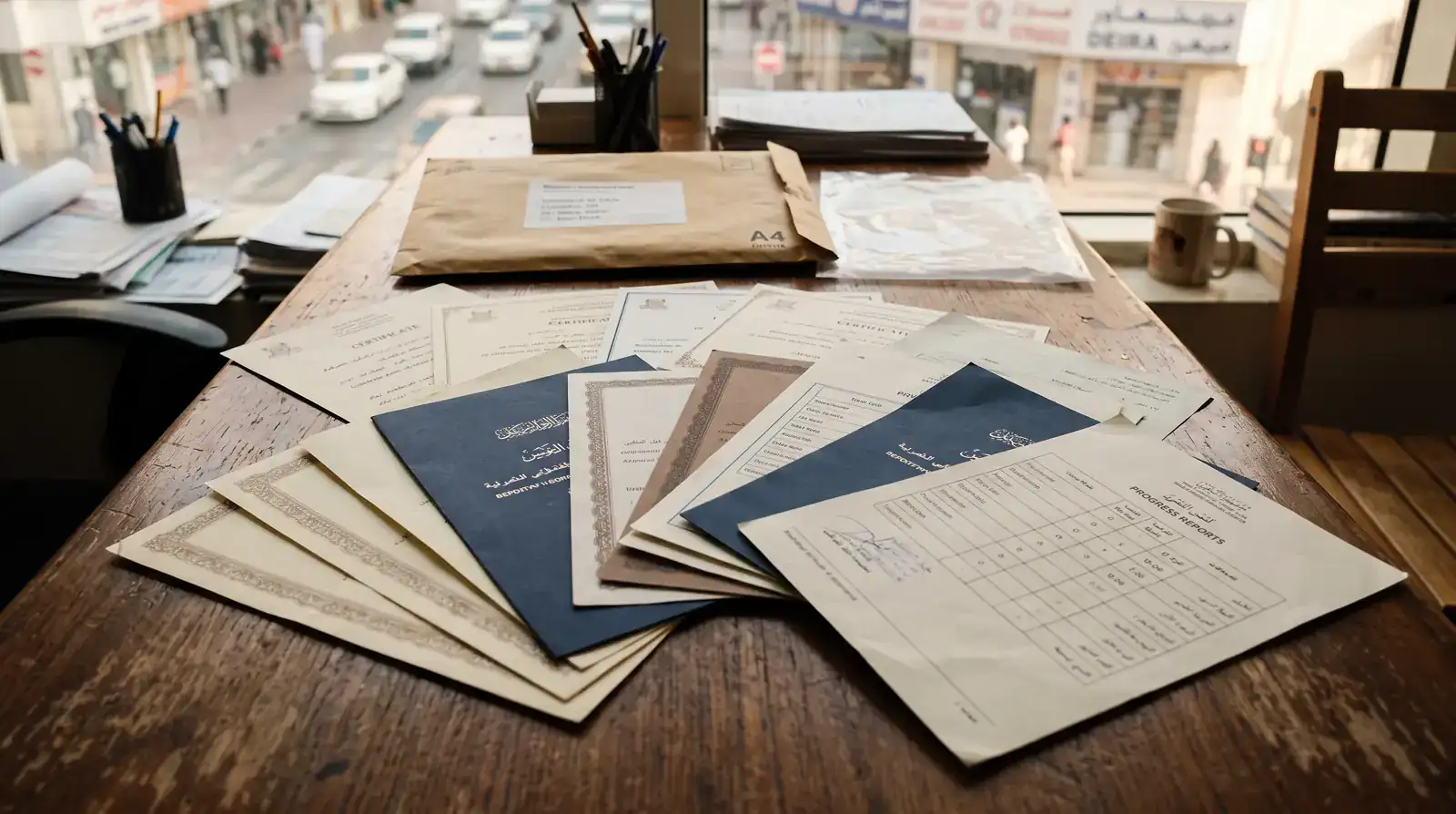
The chain, for a certificate issued abroad
Same shape as every other foreign document. Nothing about education makes it special.
- Get the certificate issued and signedFrom the school, on school letterhead, with the grade completed stated clearly. A certificate that does not name the completed grade causes a placement query later.
- Attest it in the issuing countryThrough whatever authority that country designates for educational documents, usually an education ministry, then its foreign ministry.
- UAE embassy or consulate in that countryThe step families most often try to skip because they have already left. It cannot be done from Dubai on an unattested document.
- MOFAIC attestation in the UAEThe final stamp that makes the document usable here.
- Legal translation, if neededRequired where the certificate is not in Arabic. Use a translator recognised for legal translation, not a general one. The detail is in our guide to certified legal translation.
The full chain, with fees, is set out in certificate attestation for the UAE. Do not run it in a different order. Each stamp validates the one before it, so a MOFAIC counter cannot help a document the embassy never saw.
What else the new school will ask for
The transfer certificate does not travel alone.
Expect the receiving school to want the child's attested birth certificate, passport and visa copies, Emirates ID, recent report cards, immunisation records and passport photographs. Some ask for the previous two years of reports rather than one.
Attestation on the birth certificate is its own chain and its own delay. If the child was born abroad and that certificate has never been attested, you are running two chains at once, and they do not share steps. That one is covered in birth certificate attestation.
The timing mistake almost every family makes
Families start this in July.
The school year starts in late August or early September. A foreign attestation chain is three to six weeks on a good run, and it runs through two countries, one of which has its own summer.
The arithmetic does not work, and it does not work in a way that is entirely predictable in March.
Start in the term before you move. If you know in February that you are leaving in June, get the certificate issued in June and put it into the chain the same week. The chain does not care that school is out. Consulates and ministries keep their own calendars.
A worked example: a July move that nearly missed September
A family moving from a school abroad to a Dubai private school, arriving on a June residence visa, child entering Grade 4.
They had an offer in April. They collected the transfer certificate on the last day of term in June. They landed in Dubai on 2 July and brought us the certificate on 6 July, unattested, expecting a stamp.
It could not be stamped here. The embassy step had to happen in the country they had just left.
| Step | Where it had to happen | Days it took |
|---|---|---|
| Education ministry attestation | Home country, by a relative with a power of attorney | 11 |
| Home country foreign ministry | Same | 6 |
| UAE embassy in that country | Same | 9 |
| Courier back to Dubai | Home country to Deira | 4 |
| MOFAIC attestation | Dubai | 1 |
| Total from 6 July | 31 days |
They made it. What saved them was a relative at home willing to run three counters with a power of attorney, and that is not something you can arrange in a week from Dubai.
Had they put the certificate into the chain on the day it was issued in June, the same 31 days would have finished in early July with nobody's blood pressure involved.

What to do if the old school will not release it
Separate the two reasons it might be withheld, because they have different answers.
If it is unpaid fees, the school is within its published entitlement. Settle it, under protest if you must, and pursue the dispute afterwards. The child's September start is not the right leverage to spend.
If it is not about fees, and the account is clear, escalate. KHDA regulates private schools in Dubai and handles parent complaints. Put the request in writing to the school first, keep the reply, and take that to KHDA rather than a verbal account of a conversation.
Either way, tell the receiving school what is happening. Schools deal with this every year and would rather hold a place while a certificate is chased than discover the gap in the first week of term.
MSM runs the attestation half of this from Deira, including chains that have to start in another country. Send us the certificate and the issuing country and we will tell you what the real timeline is. Start at certificate attestation services.