


A newborn arrives with a clock attached. Most parents hear about it late, and then hear a number for the fine that is twice what the authority actually publishes.
Here is the accurate version, and the honest admission of what we could not confirm.
Two very different situations
The document chain depends entirely on where the child was born, and the two routes barely resemble each other.
| Born in the UAE | Born abroad | |
|---|---|---|
| Certificate issued by | The hospital, then the relevant health authority | The foreign registrar |
| Attestation needed | MOFAIC, via the MOHAP integrated route | Full chain: home authority, home foreign ministry, UAE embassy there, MOFAIC here |
| Typical time | Minutes | Weeks |
| MOFAIC fee | AED 150, or AED 300 total on the integrated route including the UAE embassy abroad | AED 150 |
| Arabic translation | Usually already bilingual | Sometimes required after attestation |
If your child was born here, this is a short article. If they were born abroad, plan in weeks.
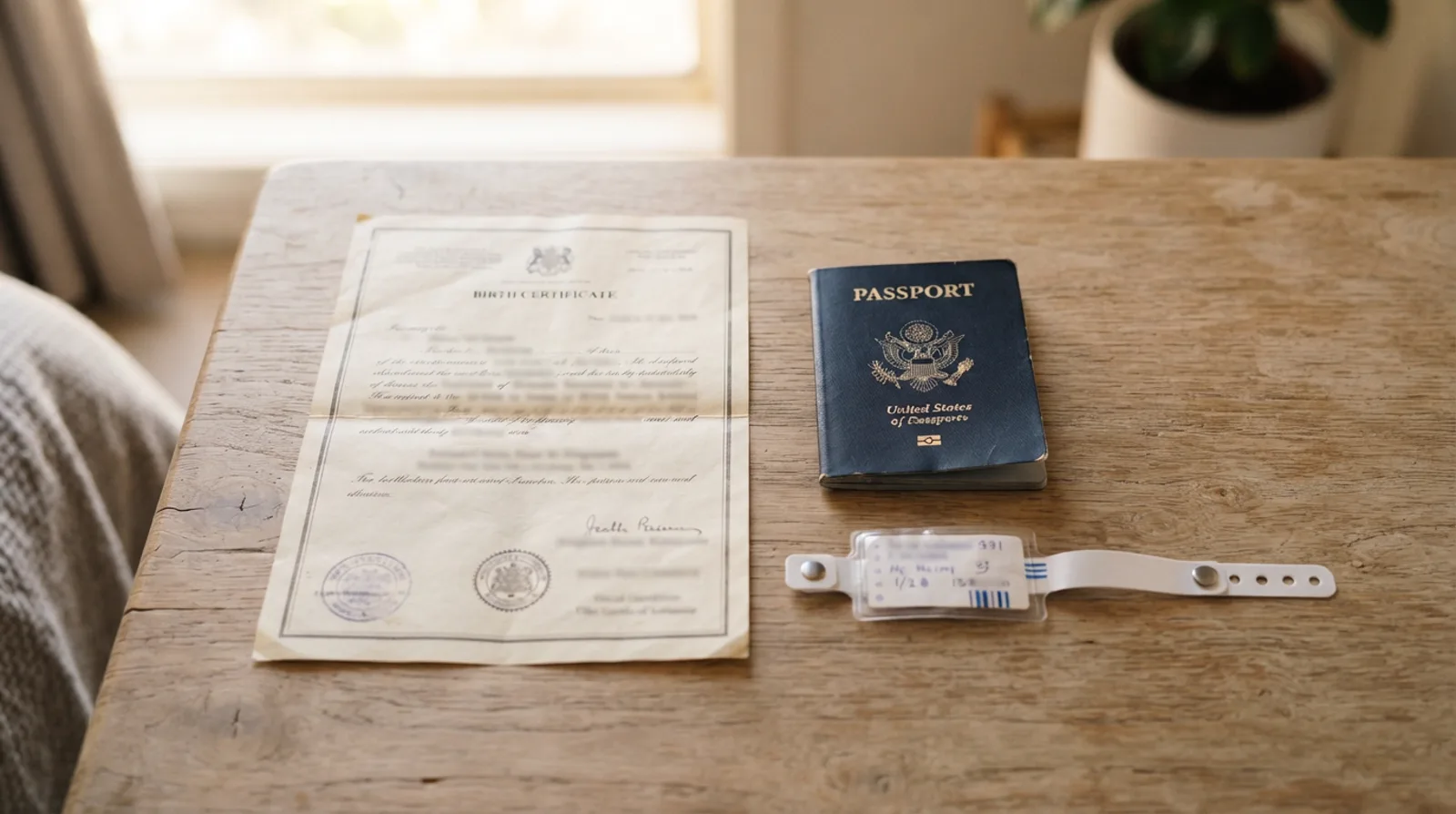
Born in the UAE
The sequence for a UAE birth:
- Hospital birth notificationIssued at discharge. This is not the birth certificate.
- Birth certificate from the health authorityIssued against the notification, the parents' passports and Emirates IDs, and the marriage certificate.
- MOFAIC attestationThrough the MOHAP integrated route, which MOFAIC describes as completing "within a few minutes, without human intervention".
- Passport for the childFrom your own country's embassy or consulate in the UAE. This is usually the slowest step in a UAE birth, and it is outside UAE control.
- Residence visa applicationThrough GDRFA Dubai, with the attested certificate and the child's new passport.
Note where the delay actually sits. The UAE side is near-instant. The bottleneck is your own embassy issuing the child's passport, and embassy processing times vary enormously by country.
Start the passport application the same week the birth certificate is issued.
Born abroad
A birth certificate issued abroad goes through the same five-link chain as any other foreign personal document.
- The issuing registrar certifies it
- The home-country designated authority for personal documents pre-authenticates it, typically the Home Department or General Administration Department
- The home-country Ministry of Foreign Affairs attests it, or the designated Apostille authority handles that step
- The UAE embassy or consulate in that country legalises it
- MOFAIC attests it in the UAE, at AED 150
An Apostille alone is not sufficient. The UAE is not among the 130 Contracting Parties on the HCCH status table dated 30 June 2026. Several UAE missions require the Apostille as the home-country step and then legalise on top of it. The UAE Embassy in Manila charges PHP 2,350 per document and takes three to five working days minimum; the UK FCDO charges £45 with a standard service usually up to 25 working days before the London embassy sees it.
Full country routes in certificate attestation for the UAE.
The newborn deadline nobody can source
Here is where we differ from every other guide on this subject.
The 120-day newborn registration deadline is quoted everywhere, usually attributed to Article 71 of Cabinet Resolution 65 of 2022. We could not reproduce it. The UAE legislation portal blocks automated retrieval, and the deadline is not stated on any u.ae, ICP or GDRFA page we reached.
That does not mean it is wrong. It means we cannot source it, and we would rather tell you that than repeat it as verified.
What is not in doubt: a fine accrues once the permitted period ends, so registering promptly is correct regardless of whether the window is 120 days or something else. Ask GDRFA or an Amer centre for the deadline that applies to your case, and get the answer in writing.
What the fine actually is
ICP publishes the fine schedule, and it settles this one clearly.
Verbatim: "Expiry of the permitted stay period for the foreigner in the State, or the cancellation or expiration of the (entry visa / residence permit / exit permit / newborn registration), per day. — 50 AED"
Newborn registration is in the same AED 50 per day line as everything else. The AED 100 per day figure that circulates widely contradicts ICP's own published schedule.
So a 30-day delay is AED 1,500, not AED 3,000. Still worth avoiding, but not the emergency some providers present it as. Detail in UAE visa overstay fines and grace periods.

What else a newborn visa file needs
GDRFA Dubai's requirements for sponsoring a child:
- Attested birth certificate
- Certified marriage contract for the parents. If issued abroad, this needs its own attestation chain, which is why it is worth doing before the child arrives. See marriage certificate attestation
- The child's passport
- Sponsor's salary evidence: AED 4,000 a month, or AED 3,000 plus accommodation
- Attested tenancy contract and the latest electricity and water bill
- Sponsor's valid Emirates ID and passport copies
Children under 18 do not require the medical fitness test, and children under 15 do not attend for biometrics. So a newborn file is mostly paperwork rather than appointments. See family visa salary requirements and biometrics for UAE residency.
Fees: GDRFA summarises the family entry permit as AED 1,035 if the sponsored person is inside the country and AED 365 if outside, processed in 48 hours.
Where birth certificates fail
Five failures specific to birth certificates.
Submitting the hospital notification. The notification issued at discharge is not the birth certificate. It is the document you exchange for one.
Parents' names inconsistent with their passports. Hospitals record names as spoken. Passports record them as printed. A mismatch on the birth certificate becomes a mismatch on the visa file.
Marriage certificate not attested. The child's file needs the parents' marriage contract certified. If that is a foreign document that was never attested, the newborn file waits on it, and that is a weeks-long dependency arriving at the worst possible moment.

Lamination. MOFAIC will not attest a laminated document, and birth certificates get laminated more often than most.
Waiting for the passport before starting attestation. These can run in parallel. Attest the certificate while the embassy processes the passport.
Two more that catch specific families. Where the parents hold different nationalities, the child's passport comes from whichever embassy you apply to, and the two may have very different processing times, so check both before choosing. And where the child was born in a third country, neither parent's own, the attestation chain runs through that country's authorities and the UAE mission there. Starting the wrong chain costs the whole leg.
A last one, which is really a records habit. Keep the attested certificate and every stamp it carries as a scanned copy. Newborn documents get requested again at school enrolment, at the next visa renewal and sometimes by a bank, and reattesting a document you already attested is money spent on a solved problem.
A sequence that works
- Before the birth: attest the marriage certificateIf it was issued abroad and has never been attested, do it now. It is the only weeks-long item and it is entirely predictable.
- Week 1: exchange the notification for the birth certificateFrom the relevant health authority, with parents' passports, Emirates IDs and the marriage certificate.
- Week 1: apply for the child's passportAt your own embassy or consulate. Usually the slowest step, and outside UAE control.
- Week 1: attest the birth certificateThrough MOFAIC. On the MOHAP integrated route for a UAE birth, this completes in minutes.
- Week 2 onward: file the residence applicationThrough GDRFA Dubai once the passport is in hand. Entry permit and residence permit each complete in 48 hours.
- Confirm the registration deadline in writingAsk GDRFA or an Amer centre what applies to your case, rather than working from a number you read online.
MSM handles newborn documentation end to end, including the marriage certificate attestation that the file depends on. Send us your situation and we will tell you which steps can start today. See certificate attestation or family visa services.