


Arabic is the official language of UAE courts and government. That single fact generates a lot of unnecessary spending, because people extrapolate from it that everything needs translating.
Most things do not. Here is where the line actually falls.
When Arabic is genuinely mandatory
A sworn Arabic translation by a Ministry of Justice licensed translator is required where a document is going to be read by a body that operates in Arabic and relies on it legally. In practice:
- Court proceedings. Any document submitted in litigation, in any UAE court
- Notary public. Powers of attorney, declarations and agreements being notarised
- Public prosecution and enforcement matters
- Certain government departments where the file is assessed in Arabic
- Contracts intended to be enforceable in UAE courts, where the Arabic version typically prevails
Dubai Courts illustrates the principle in its own requirements for a power of attorney issued abroad: the document must be attested through the foreign ministry of the issuing country, the UAE embassy there, and MOFAIC here, before it can be ratified. A document going to a court has to be both genuine and readable.
When it is not
The list of things that usually do not need a sworn Arabic translation is longer than people expect:
- A routine residence visa application where the underlying documents are attested
- Most bank account opening, where English documents are accepted
- Free zone company formation, where the zone works in English
- Employment contracts issued in English by a UAE employer
- Documents you are keeping for your own records
The honest position is that requirements vary by receiving authority, and the only reliable method is to ask the body that will read it. That is a less satisfying answer than a rule, but it is the accurate one, and it is cheaper than translating a stack of documents nobody asked for.
What makes a translation "legal"
Three things distinguish a legal translation from an ordinary one.
The translator is licensed. Registration on the Ministry of Justice list and a licence from the competent licensing authority. Without both, the profession may not be practised.
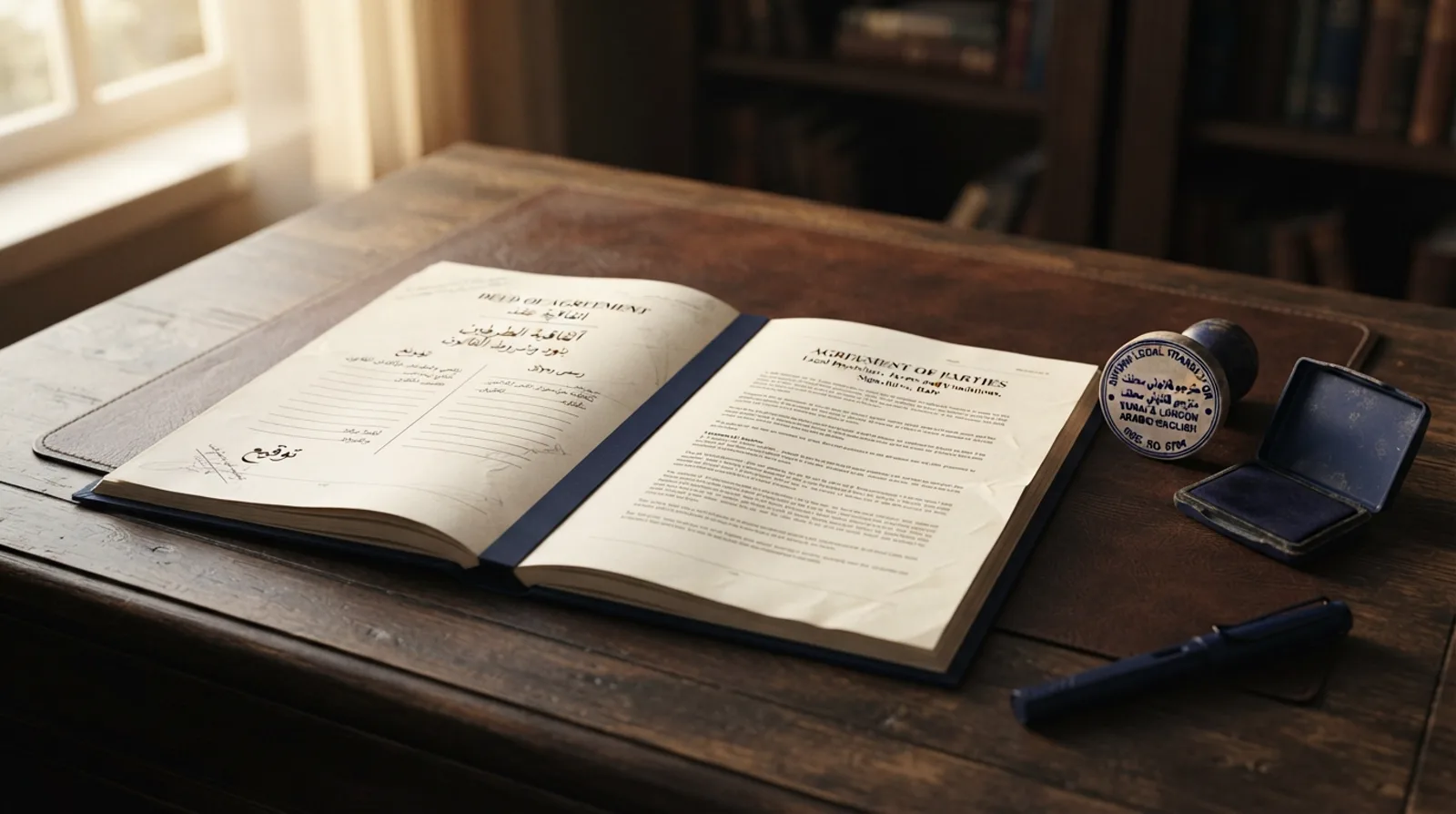
It carries a sworn declaration. The translator's stamp, signature and licence number, declaring the translation faithful to the original.
It is attached to the original. A sworn translation is bound to the specific document it translates, which is why it cannot be produced before attestation is complete.
An accurate translation by a fluent bilingual professional is not a legal translation. The difference is not quality; it is standing.
The law behind it
The regulatory picture, with a caveat about how firmly we can state it.
The profession was governed by Federal Law 6 of 2012 on the Regulation of the Translation Profession, with its executive regulation in Cabinet Resolution 7 of 2014.
That was replaced by a newer federal decree-law regulating the translation profession, reported as Federal Decree-Law 22 of 2022, effective 2 January 2023, with executive regulations in Cabinet Decision 18 of 2024 and an implementing Ministerial Decision 215 of 2024 issued 15 May 2024. Oversight sits with a Translators Affairs Committee and a Translators Disciplinary Board within the Ministry of Justice.
We are flagging the decree number rather than asserting it. The UAE legislation portal blocks automated retrieval, so we could not read the decree number off the primary text. The framework is well corroborated by legal practitioners; the specific numeral is worth confirming if you are citing it in a document of your own.
| Requirement | Amount |
|---|---|
| Professional indemnity insurance, individual translator | AED 1,000,000 minimum |
| Professional indemnity insurance, translation house | AED 5,000,000 minimum |
| Policy conditions | Issued by a local UAE insurer, minimum 3-year term, non-revocable during registration validity, claims paid within 30 days |
Those insurance figures tell you something useful about how the UAE views this work. A mistranslated contract clause or an inaccurate court submission is treated as a professional liability at the same scale as other regulated professions. You are not buying a language service. You are buying a document somebody has insured.

How to verify your translator
Four checks, and they take five minutes.
- Ask for the Ministry of Justice licence numberEvery registered legal translator has one. A translator who hesitates at this question is answering it.
- Check the language pair on the licenceRegistration is per language pair. An English-Arabic licence does not cover Urdu-Arabic.
- Confirm the stamp will be appliedA sworn translation carries the translator's stamp, signature and licence number. Without those it is just a translation.
- Ask about indemnity coverIndividuals must carry AED 1 million and translation houses AED 5 million. It is a licensing condition, so a registered provider can answer it immediately.
Where translation sits in the sequence
The order matters and getting it wrong costs the whole translation fee.
- Attest the original document firstThe full chain: issuer, home-country authority, home foreign ministry, UAE embassy in that country, MOFAIC here. See certificate attestation for the UAE.
- Then translateThe sworn translation is produced against the attested original, including its stamps.
- Then submitTo the court, notary or authority that required it.
Translating before attestation means the translation does not reflect the final document, because the attestation stamps themselves are part of what a court reads. You pay twice.
This is the single most common sequencing error we see on family visa and litigation files alike. Detail in marriage certificate attestation.
What it costs
We are not going to publish a per-page rate, and the reason is worth explaining.
Legal translation pricing in the UAE is commercial and unregulated. No government body publishes a tariff. Rates vary by language pair, document complexity, urgency, and whether the provider is an individual translator or a translation house carrying AED 5 million of cover.
What we can tell you about the shape of it:
- Pricing is generally per page, and a "page" is usually defined by word count rather than physical page
- Rare language pairs cost more than English-Arabic
- Technical, medical and legal content costs more than personal documents
- Same-day work carries a premium
- Notarisation, if required afterwards, is a separate fee to the notary
Get a written quote against the actual document, with the number of pages stated. A provider quoting a rate before seeing the document is guessing, and the guess is rarely in your favour.
For context on what is regulated: the Ministry of Justice legal translator registration itself is reported at AED 3,000 with a 65-day process. That is what the translator pays, not what you pay.

How documents fail at this step
Five failure modes.
- Translated before attestation. The translation does not include the attestation stamps and is rejected. Most common by a distance.
- Not by a licensed translator. An accurate translation without MoJ registration has no standing at a court or notary.
- Wrong language pair on the licence. Registration is per pair, and it is checked.
- Names transliterated inconsistently. The Arabic rendering of a name must match across every document in the file. Two translators can produce two spellings of the same name, both defensible, and the file bounces.
- Partial translation. Every element of the original, including stamps, seals and marginal notes, forms part of the document.
MSM handles Ministry of Justice legal translation alongside attestation, so the sequence runs correctly and the Arabic spelling of names stays consistent across your whole file. See certified legal translation or translation and attestation.