
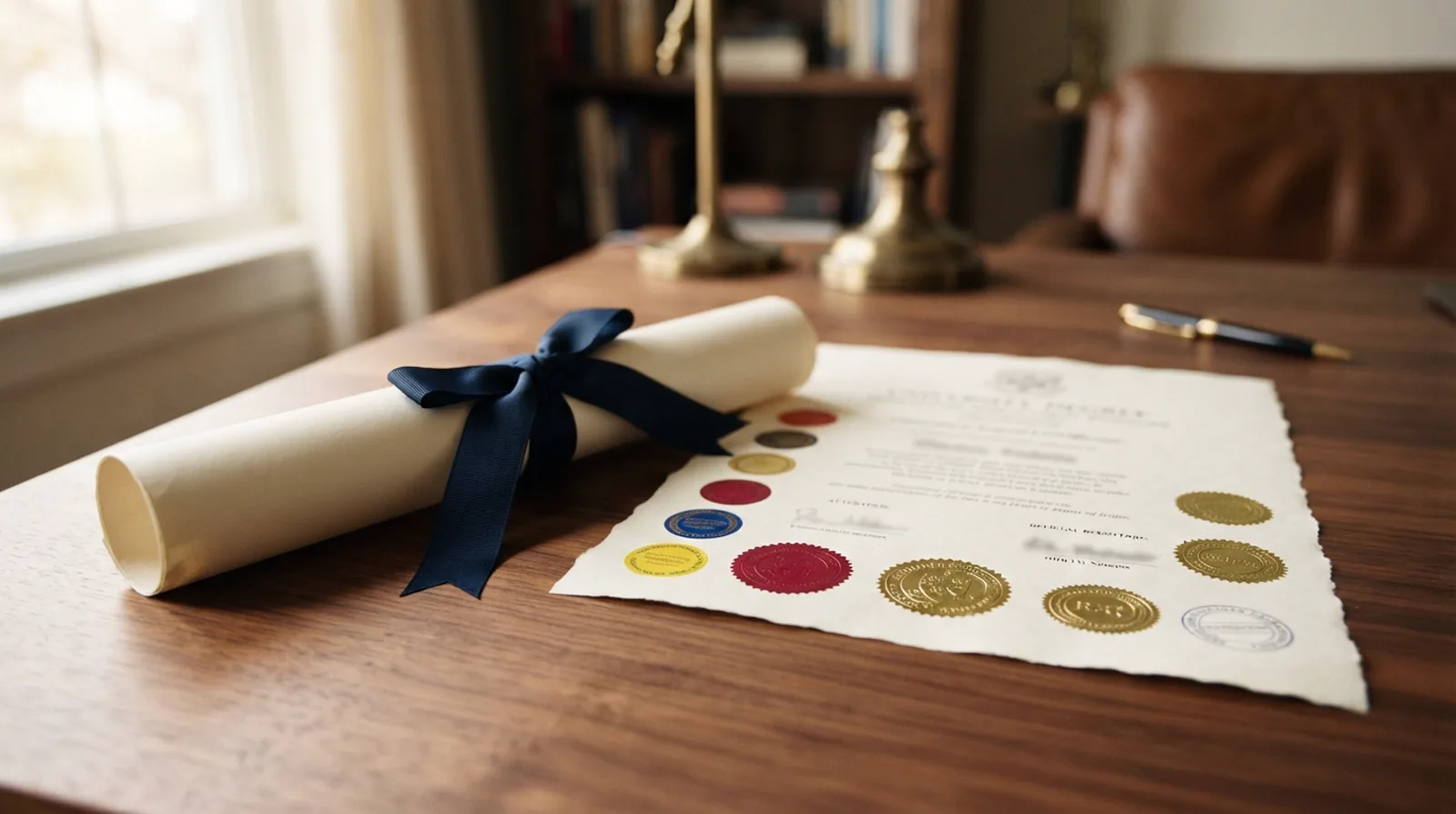
A degree certificate is the document most often attested unnecessarily, and the one most often attested too late. Both mistakes are avoidable, and both come from the same place: not asking who is going to read it.
Do you actually need it?
Start here, because it saves some people several weeks and a few thousand dirhams.
You generally need an attested degree for:
- A work permit in a regulated or skilled profession, where the qualification is part of the file
- Professional licensing: medicine, pharmacy, engineering, teaching, law
- Certain Golden Visa routes, including executive directors, PhD holders and priority specialists
- Equivalency applications through the Ministry of Education
- Some free zone and mainland licences where the activity requires a qualified individual
You generally do not need it for an ordinary employment visa in an unregulated role, or to open a bank account, or to sponsor family.
The UAE Government portal, on preparing to work, states that foreign educational certificates must be attested by the foreign ministry of the issuing country and then by the UAE embassy or consulate in that country. That page is about employment; it is the right source for the requirement, not the trigger for it.
The chain, in order
- University or issuing institutionConfirms the certificate is genuine, usually by verification request rather than a stamp.
- Home-country designated authority for educationThe state education department, HRD, HEC, IBCC or technical board, depending on the country.
- Home-country Ministry of Foreign AffairsOr the designated Apostille authority where that body handles this step.
- UAE embassy or consulate <em>in that country</em>Cannot be skipped and cannot be done from Dubai. This is the step people try to shortcut.
- MOFAIC inside the UAEThe final attestation. AED 150 for an educational certificate.
Why the Apostille does not shortcut this: the UAE is not among the 130 Contracting Parties on the HCCH status table dated 30 June 2026, and the Convention operates only between parties. Several UAE missions now require an Apostille as the home-country step and then legalise on top of it. Full explanation in certificate attestation for the UAE.
India
India has been an Apostille member since July 2005, and for a UAE-bound degree that is irrelevant.
The route is MEA Normal Attestation. The MEA describes it itself: for nations outside the Convention, it "legalises the documents on the basis of the signature of the designated signing authorities of the State Government/Union Territory/Chambers of Commerce."
Educational documents must first be pre-authenticated by the Education Department or HRD of the concerned State Government or Union Territory. This is the step that varies most by state and takes the longest.
| MEA fees | Normal Attestation (the UAE route) | Apostille (not the UAE route) |
|---|---|---|
| MEA fee | Free | ₹50 per document or page |
| Agency charge | ₹84 per document | ₹84 per document |
| Scanning | ₹3 per page | ₹3 per page |
Since July 2012 the MEA has not accepted documents from individuals at its counter. Submission runs through authorised outsourcing agencies across sixteen cities via Regional Passport Offices and Regional Authentication Centres.
One inconsistency worth knowing: an older MEA page still lists legacy agency charges of ₹22, ₹18 and ₹16. The 26 May 2026 page's ₹84 supersedes it. MEA's own two pages disagree, which is a good reminder to work from the most recently updated one.
After MEA, the document goes to the UAE Embassy in New Delhi or the Consulate in Mumbai, then to MOFAIC here. Typical elapsed times reported by the industry: state HRD 5 to 15 working days, MEA 3 to 5, UAE embassy 3 to 7, MOFAIC 1 to 3. No official service level exists for the whole chain.
Pakistan
Pakistan's chain runs through the qualification body first.
- HEC for university degrees
- IBCC for SSC and HSSC certificates
- The relevant technical board for technical qualifications
Then MOFA Pakistan, then the UAE Embassy in Islamabad or the Consulate in Karachi, then MOFAIC.
| MOFA Pakistan document type | Official fee (PKR) |
|---|---|
| Educational | 3,000 |
| Personal | 3,000 |
| Experience certificate | 3,000 |
| Legal | 4,500 |
| Commercial | 12,000 |
Two rules from MOFA Pakistan's own SOPs. "This Ministry will only attest the documents in Urdu/English." And online appointments are required, with no walk-ins.
Agent sites quoting PKR 2,500 per document are below the official PKR 3,000. Use the official figure when budgeting.
Reported timings: university verification 5 to 8 days plus HEC review 3 to 5 days, so 10 to 15 working days for the HEC stage alone. The full IBCC to MOFA chain is reported at 4 to 6 weeks.
Philippines
The clearest illustration that an Apostille is a prerequisite rather than a substitute.
The DFA is the Philippines' Apostille Competent Authority, and the UAE Embassy in Manila states: "All documents for authentication to the Embassy must bear the DFA Apostille."
So: DFA Apostille, then UAE Embassy legalisation at PHP 2,350 per document, taking three to five working days minimum, then MOFAIC in the UAE.
Same-type documents can be grouped into one transaction at the embassy, which is worth doing if you are attesting a degree and a transcript together.
Submission runs through the MOFAIC website or UAEMOFA app, by courier such as DHL, or in person by email appointment.
United Kingdom
The UK route is the slowest of the four, and the reason is the FCDO rather than the UAE.
| FCDO service | Fee | Time |
|---|---|---|
| Standard | £45 per document | Usually up to 25 working days plus courier |
| Premium / Restricted Urgent | £100 | Same day, registered businesses only, pre-approved applications |
| Courier | £5.50 UK to £29.50 per 1.5kg rest of world | — |
Then the UAE Embassy in London, which is postal only. Its page states: "Documents cannot be submitted or collected in person, they will be accepted only by post."
You need the online payment receipt, a covering letter, a self-addressed registered envelope, and front-and-back photocopies of each document. Up to five working days. Payment is online only, with a transaction fee of AED 3 plus 2%. Address: 48 Princes Gate, London SW7 2QA.
Add it up and a UK degree can take six weeks before MOFAIC sees it. Plan accordingly, and note that documents apostilled as a bundle are not accepted; each goes separately.
What MOFAIC charges and how long it takes
| MOFAIC step | Detail |
|---|---|
| Educational certificate fee | AED 150 per document |
| Digital attestation | Within 2 hours during business hours |
| Courier-based attestation | 1 to 3 business days |
| Courier options | Aramex AED 40 regular / 150 express; Emirates Post 31.50 / 105; Zajel 31.50 / 126; Tawzea 36.70 / 95 |
| Capacity | Up to 25 documents per regular transaction, 10 per express |
| Rejected applications | Refunded within 14 working days |
| Channels | mofa.gov.ae with UAE PASS sign-in, or the UAEMOFA app |
Note the contrast. MOFAIC is two hours. The UK leg is up to five weeks. When someone says "attestation takes ages", they almost always mean the part that happens abroad.
Why degree files get rejected
Six causes, in the order we see them on degree files specifically.
- Lamination. MOFAIC will not attest a laminated document, and universities laminate degrees more often than any other certificate. There is usually no fix short of reissuing.
- Name mismatch with the passport. Middle names, initials, maiden names. Resolve before the chain starts.
- Wrong state department in India. A degree routed through the Home Department instead of Education comes straight back.
- Provisional certificate instead of the final degree. Provisional certificates are frequently refused. Get the final one.
- Transcript without the degree. Some authorities want both, and attesting one without the other means going round twice.
- Bundling. Each document is apostilled and legalised separately, not as a set.
How to shorten the timeline
- Confirm it is genuinely requiredOne email to whoever asked. Unregulated employment visas usually do not need it.
- Order a fresh, unlaminated originalBefore anything else, and before anyone helpfully laminates it.
- Start the home-country leg immediatelyIt is 80% of the elapsed time. Everything else can wait; this cannot.
- Do the degree and transcript togetherSame-type documents can often be grouped in one embassy transaction, and you avoid a second full chain.
- Check your name matches the passport exactlyEvery letter. This is the cheapest check on the list and it prevents the most expensive failure.
- Use MOFAIC digital attestation at the endTwo hours during business hours, once the document arrives with its embassy stamp.
MSM coordinates degree attestation chains for applicants from more than twenty countries, including the embassy legs, and files the MOFAIC step from Dubai. Send a photo of the certificate and tell us which country issued it. See certificate attestation or translation and attestation.