


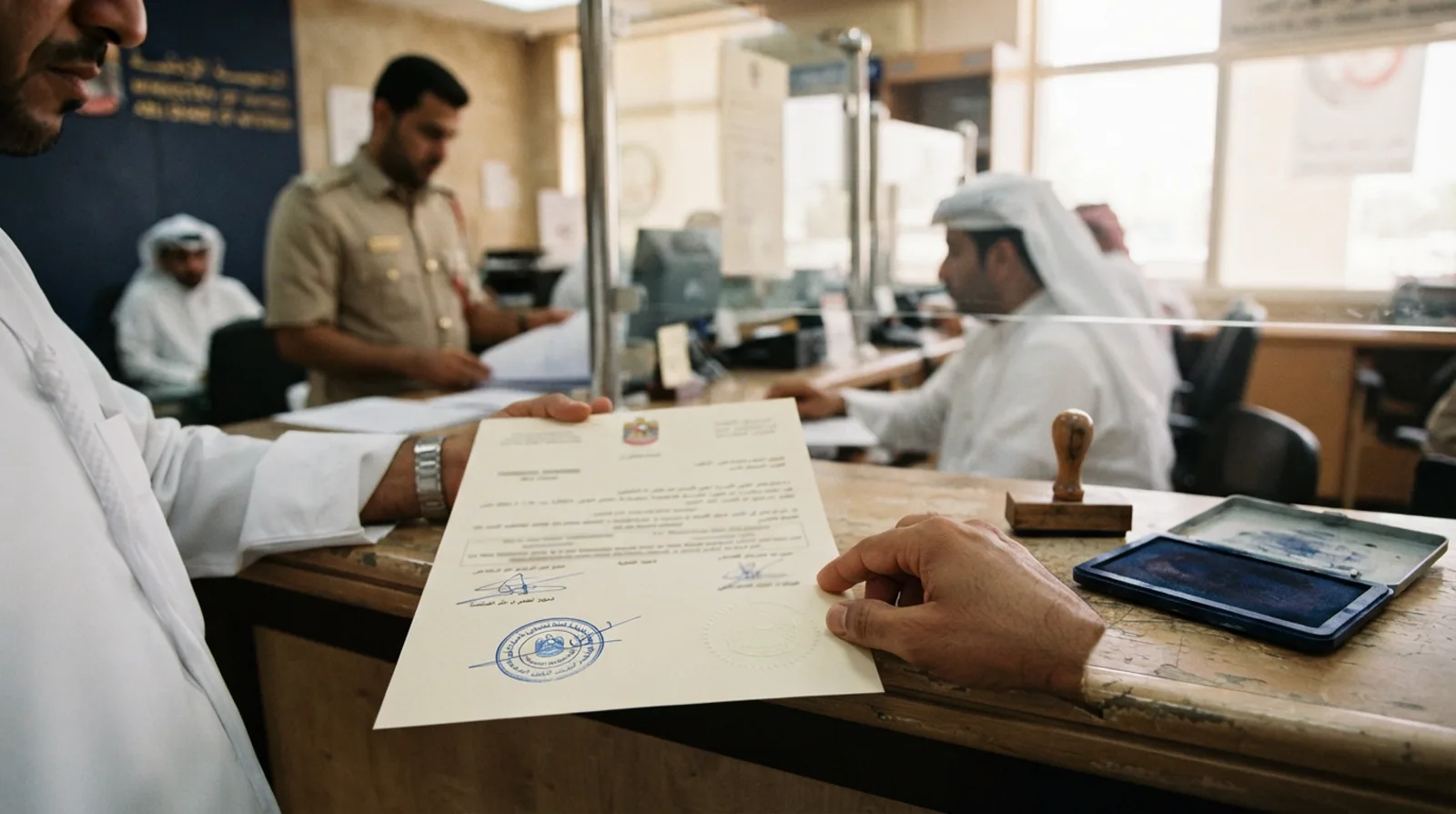
MOFAIC is the step everyone dreads and it is, by a wide margin, the easiest part of attestation. Two hours, AED 150, done on a phone.
What makes it feel hard is that people arrive at it with a document that was never ready.
What MOFAIC attestation is
The Ministry of Foreign Affairs and International Cooperation certifies that the stamp before it is genuine. That is the whole function.
For an inbound document, one issued abroad and used here, MOFAIC verifies the UAE embassy's legalisation from the issuing country. It is the last link.
For an outbound document, one issued in the UAE and used abroad, MOFAIC certifies it first, and the destination country's embassy legalises after. Same ministry, opposite end of the chain.
Three UAE authorities describe the inbound sequence identically: Dubai Courts, MOFAIC's own FAQ, and the UAE Government portal. When the courts, the foreign ministry and the national portal all say the same thing, that is the sequence.

When a document is ready for it
A foreign document is ready for MOFAIC when it already carries the UAE embassy or consulate stamp from the country that issued it.
Not before. This is the single most common reason a MOFAIC submission is rejected: people assume the ministry can attest a foreign document directly, and it cannot.
Working backwards, the document should have:
- The issuer's or notary's certification
- The home-country designated authority's stamp (education department, HRD, home department, chamber of commerce, HEC, IBCC, depending on document and country)
- The home-country foreign ministry's attestation, or its Apostille where that authority handles the step
- The UAE embassy or consulate legalisation in that country
If step four is missing, MOFAIC is not the next step. The full picture is in certificate attestation for the UAE.
The fee schedule
| Document type | MOFAIC fee (AED) |
|---|---|
| Individual affairs / personal status: birth, death, marriage, divorce | 150 per document |
| Educational certificate and other personal certificates | 150 per document |
| Commercial document | 2,000 per document |
| Commercial invoice or certificate of origin via eDAS 2.0 | 150 flat per invoice |
| Birth or death certificate via the MOHAP integrated route | 300 total (150 MOFAIC + 150 UAE embassy abroad) |
| School certificate via the Emirates Schools Establishment route | 150 MOFAIC + 150 UAE embassy |
| Online payment transaction fee (London mission) | AED 3 + 2% per transaction |
The legal basis is Cabinet Resolution 38 of 2022 on attestation fees for documents, bills and certificates of origin, issued 21 April 2022 and in force from 1 September 2022. The invoice-attestation obligation for imports of AED 10,000 or more took effect 1 February 2023, with a reported AED 500 fine per unlinked or unattested invoice.
The gap between AED 150 and AED 2,000 is why document classification matters so much. Get a document classified as commercial when it is personal and you have overpaid by more than thirteen times.
The power of attorney conflict
One genuine conflict, and it is expensive if you guess wrong.
MOFAIC's FAQ prices a non-commercial power of attorney at AED 150. The UAE Embassy in Amman states that "powers of attorney and commercial certificates cost AED 2000".
Both are official UAE pages. The practical reading is that classification turns on whether the POA is commercial in nature: a POA to sell a property or manage a company reads differently from one authorising a relative to collect a document.
Our advice: budget AED 2,000 for a power of attorney and be pleased if it comes in at AED 150. Confirm the classification with MOFAIC for your specific document before submitting.
How long each channel takes
| Channel | Published time |
|---|---|
| MOFAIC digital attestation | Within 2 hours during business hours |
| MOFAIC courier-based attestation | 1 to 3 business days |
| eDAS 2.0 invoice or certificate of origin | 2 minutes, 24/7 |
| School certificate via the Emirates Schools Establishment link | 3 minutes (previously six days) |
| MOHAP birth or death certificate | "Within a few minutes, without human intervention" |
| UAE Embassy London (for comparison) | Up to 5 working days, postal only |
| UAE Embassy Manila (for comparison) | 3 to 5 working days minimum |
The last two rows are there to make a point. MOFAIC is measured in minutes and hours. The embassy legs abroad are measured in days and weeks, and the FCDO step before the London embassy is usually up to 25 working days.
When a client says attestation is slow, the MOFAIC step is almost never what they mean.
Courier options within the UAE: Aramex at AED 40 regular or AED 150 express; Emirates Post at AED 31.50 or AED 105; Zajel at AED 31.50 or AED 126; Tawzea at AED 36.70 or AED 95. Capacity is up to 25 documents per regular transaction and 10 per express. Rejected applications are refunded within 14 working days.

The 2026 pilot digital service
MOFAIC launched a pilot digital attestation service on 27 April 2026, and it is a genuine simplification.
Reported changes: the process cut from eight steps to three and from two procedures to one; QR codes, reference numbers and barcodes added for verification; up to five documents per application; completion within two working days during the pilot.
It covers UAE-issued documents destined for countries where UAE embassies operate. Fees were not disclosed at launch.
This is reported through news coverage of an official announcement rather than from a MOFAIC release we could retrieve, so treat the specifics as directional until the ministry publishes them. The direction of travel is not in doubt.
UAE documents going abroad
Reverse the chain.
A UAE-issued document going abroad is attested by MOFAIC first, then legalised by the destination country's embassy in the UAE.
Two integrated routes make this near-instant for common documents. Birth and death certificates through the MOHAP integration complete "within a few minutes, without human intervention". School certificates through the Emirates Schools Establishment link take three minutes, down from six days.
For a UAE trade licence, MoA or commercial document going abroad, expect the AED 2,000 commercial rate and plan for the destination embassy's own timeline, which MOFAIC does not control.
Why files get rejected at this stage
Five reasons, in order of frequency.
- Missing the UAE embassy stamp from the issuing country. The document was never ready. This is most of them.
- Lamination. MOFAIC states documents must not be laminated. There is usually no fix short of reissuing the original.
- Wrong classification. A commercial document submitted as personal, or vice versa.
- Poor scan quality. Stamps and seals must be legible in the uploaded image.
- Name mismatches. Between the document and the passport, or between documents in the same submission.
Rejections are refunded within 14 working days, so a failed submission costs time rather than money. Time is usually the thing you have least of.
How to submit
- Confirm the embassy stamp is on itFor a foreign document, the UAE mission in the issuing country must have legalised it already. Check before you pay.
- Sign in at mofa.gov.ae with UAE PASSChoose "Attestation through UAE Missions Abroad" for foreign-issued documents. Or use the UAEMOFA app on Android or iOS.
- Scan properlyFull page, flat, all stamps legible, no shadows across a seal.
- Classify the document honestlyPersonal at AED 150, commercial at AED 2,000. For a power of attorney, budget the higher figure.
- Use digital rather than courier where you canTwo hours against one to three business days, and no courier fee.
- Keep the referenceThe 2026 pilot adds QR codes and reference numbers for verification. Whoever receives the document may want to check it.
Support: toll-free 80044444, WhatsApp on the same number, and Tawasul on 171.
MSM runs the whole chain, including the embassy legs abroad, and files the MOFAIC step from Dubai. Send a photo showing the stamps already on the document and we will tell you whether it is ready. See certificate attestation, degree attestation or translation and attestation.