


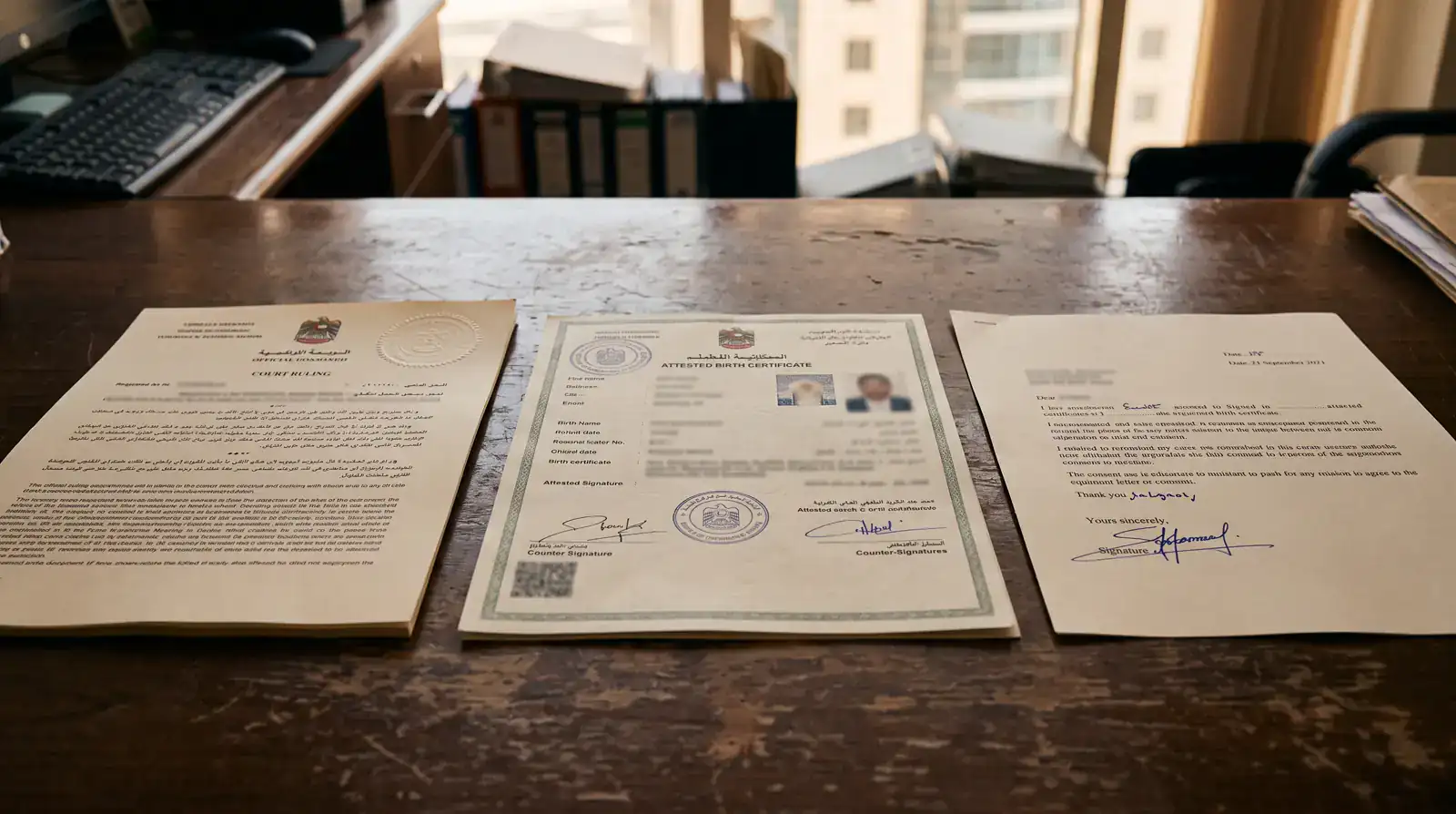
The standard family file is built on lineage.
An attested birth certificate proves a child is yours. That single document carries the whole relationship, and every part of the process assumes it exists and says what you need it to say.
A stepchild's birth certificate names someone else.
That is the entire difficulty, and once you see it that way the route becomes obvious rather than mysterious.
Why a stepchild is not simply a child on your file
GDRFA's family entry permit card asks for an attested birth certificate for child sponsorship. Its purpose is to establish that the sponsor is the parent.
For a stepchild, that document establishes the opposite. It names a biological parent who is not the sponsor, and who may be in another country, or estranged, or deceased.
So the standard route does not fail because anyone objects to blended families. It fails because the document it is built around answers a different question.
| Relationship | What the birth certificate shows | Route |
|---|---|---|
| Your biological child | You as the parent | Standard family residence entry permit |
| Your spouse's child from a previous marriage | Your spouse and someone else | Humanitarian residence permit, stepchildren category |
| A child under your legal custody | Their biological parents | Humanitarian residence permit, foster children under custody |
| A child under your guardianship | Their biological parents | Humanitarian residence permit, wards |
| An adult child over 25 in education | You as the parent, but age blocks the standard route | Humanitarian residence permit, adult children pursuing studies |
The route that actually exists
The humanitarian residence permit is a real, published, named service, and it is worth saying that clearly because families arrive believing they are asking for an exception.
They are not. They are applying for the category that exists for them.
GDRFA grants foreigners a one-year, renewable residence permit, provided they have a sponsor or host who meets the applicant's humanitarian needs. The qualifying categories are broad: parents and parents-in-law, spouse and children in low-income cases, siblings, stepchildren, adult children aged 25 and over pursuing studies, wards under guardianship, foster children under custody, widowed or divorced women, grandchildren, and nationals affected by war or disaster.
Two features change how you plan. It is annual rather than multi-year, so it renews more often than a standard family residence. And every request goes to a committee, which means the timeline is 14 days rather than 48 hours.
What the committee is deciding
Committee review, case by case, is stated on the service card. So it is worth understanding what a committee is looking at, because it changes how you present a file.
Our reading, from the documents the card requires, is that three things are being established.
That the relationship is real and documented. Not asserted. Marriage certificate, birth certificate, custody ruling, whichever applies.
That the sponsor can actually support the child. Hence salary from AED 10,000 for most cases, three months of bank statements, and an attested tenancy contract that shows where the child will live.
That there is a genuine humanitarian need for this arrangement rather than a convenience. A child whose mother is your wife and who lives with you is an obvious case. The card does not spell out how the need is weighed, and we are not going to guess at criteria that are not published.
Present the file as an answer to those three questions and it reads well. Present it as a pile of documents and somebody has to assemble the story themselves.
The documents, and the one that takes longest
The published list is heavier than a standard family file, and one item dominates the timeline.
- Proof of the relationshipMarriage certificate linking you to the child's parent, and the child's birth certificate. Both attested. If either was issued abroad and never attested, this is the four to six week item and it is the reason to start today.
- The custody or consent documentWhere the other biological parent is living, this is the hardest item on the file and it is covered in its own section below.
- Salary evidenceThe card indicates a minimum of AED 10,000 for most cases, which is materially above the AED 4,000 standard family threshold. Establish this first, because no amount of document work compensates for falling short.
- Three months of bank statementsNot one month. The committee is reading for sustained capacity.
- Attested tenancy contractThe same Ejari logic that runs through every family file. See Ejari and the housing requirement.
- Passport copies for everyoneSponsor, spouse and child.

The consent problem, stated plainly
Here is the honest centre of this subject.
A stepchild has another biological parent. That parent has rights over the child, and the UAE system, like most systems, wants documentary evidence that moving the child to another country is not happening over their objection.
That evidence takes one of three forms. A consent from the other parent, certified and attested. A custody ruling awarding your spouse the authority to make that decision. Or a death certificate, attested, where the other parent has died.
All three are foreign documents in most cases, and all three run the full attestation chain: issuing country, UAE embassy there, then MOFAIC. Three to six weeks, sometimes considerably longer where a court has to be approached first.
Adopted children and the lineage question
Adoption needs care, because legal frameworks differ substantially between countries and the UAE has its own approach to lineage.
What we can point to is that GDRFA's humanitarian permit names foster children under custody and wards under guardianship as distinct qualifying categories. Both are framed around custody and guardianship rather than around a transfer of parentage.
That framing is the practical guidance. Bring the custody or guardianship instrument, attested, and let it speak for itself. A file built around the vocabulary of the issuing country's adoption law, without the underlying custody documentation, is harder to assess.
Beyond that we are not going to generalise. Adoption arrangements vary too much between jurisdictions for a blog to tell you how yours will be treated, and this is a situation where a direct conversation with GDRFA, with your documents in hand, is worth more than any amount of reading.
What it costs, with the guarantee included
The published fees, and the item nobody budgets for.
| Line | Published amount |
|---|---|
| Residence permit | AED 200 |
| Knowledge dirham | AED 10 |
| Innovation dirham | AED 10 |
| Domestic processing | AED 500 |
| Delivery | AED 20 |
| Annual increase after two years | +AED 100 per year |
| Financial guarantee | AED 5,000 per request, capped at AED 15,000 in total |
The AED 5,000 guarantee per request is the line that surprises people, particularly a family bringing more than one child, where it climbs toward the AED 15,000 cap.
It is a guarantee rather than a charge, which is a genuine distinction, but it has to be available when you file. A family that has budgeted the fees and not the guarantee arrives at the counter short.
Add the attestation costs, which are the other real number and which depend entirely on how many foreign documents your situation requires.
A worked example: a blended family arriving together
A file from last year. Details changed, structure intact.
Sponsor moving to Dubai on an employment package of AED 16,000. Wife, her nine-year-old son from a previous marriage, and their own four-year-old daughter. The son's father was alive, remarried, living in a third country, and on reasonable terms with everyone.
Two children, two entirely different processes.
| Daughter, 4 | Stepson, 9 | |
|---|---|---|
| Route | Standard family entry permit | Humanitarian residence permit |
| Key document | Attested birth certificate naming both parents | Attested birth certificate plus the father's certified consent |
| Published completion | 48 hours | 14 days |
| Permit validity | Standard family residence | One year, renewable |
| Financial guarantee | None | AED 5,000 |
| Actual elapsed time | 3 weeks | 15 weeks |
Twelve of the stepson's fifteen weeks were the father's consent: getting it drafted correctly, notarised in his country, attested there, through the UAE embassy, and then MOFAIC.
He was cooperative throughout. Nobody was obstructing anything. It simply took that long, because it always takes that long, and the family had started it in week six instead of week one.
Had they begun the consent the day they accepted the job offer, both children would have arrived within about a month of each other.

How to start this without wasting six months
Three moves, in this order, and the order is the whole point.
Start the consent or custody document today. Before the job, before the flights, before you have an address in Dubai. It is the only item measured in months and the only one that depends on people in another country. Everything else waits comfortably; this does not.
Check the salary condition against AED 10,000, not AED 4,000. The humanitarian route indicates a materially higher figure for most cases. A sponsor who qualifies comfortably for a standard family file may not qualify for this one, and that is better discovered now than after a consent has been obtained.
Then do the UAE side, which is quick. Sponsor file, Ejari, bank statements, application. Fourteen days published, and in our experience it runs to that.
One closing thought worth stating. Families in this situation often arrive apologetic, as though a blended household is an awkward case the system would rather not deal with. GDRFA published a category for it, named it, and set out its documents. Use it as the ordinary route it is.
MSM runs stepchild and custody files from Deira, including chains that start in another country. Send us the situation early. Start at family visa services.