



A family of four walks into a Dubai medical fitness centre. Two of them get tested. Two do not.
Which two depends on one number, and it is not a number about health. It is age.
This page is the medical step on a family residence file, specifically for dependants. The general test, including the profession-based vaccination rules that apply to workers, is covered in the Dubai medical fitness test. What follows is the narrower version, for people sponsoring a spouse, a parent or a child.
Who actually has to sit it
The UAE Government portal is unambiguous. Male and female family members who are to be sponsored and who have completed the age of 18 undergo and must pass medical fitness tests at approved health centres.
The general residence provisions say the same thing from the other direction: applicants aged 18 and above take a medical test to prove they are medically fit, and those under 18 are exempt.
So on a family file:
| Who you are sponsoring | Medical fitness test? | Why |
|---|---|---|
| Spouse | Yes | An adult family member over 18 |
| Child under 18 | No | Under the published age threshold |
| Son aged 18 to 24, still on your file | Yes | He has completed 18. Age of sponsorship eligibility and age of medical testing are separate rules |
| Unmarried daughter over 18 | Yes | Same reason |
| Parent | Yes | Adult family member |
| Newborn born in the UAE | No | No test, and no fingerprints either until 15 |
That table answers roughly four out of five questions we get on this. The rest are about the day itself.
Why the age rule confuses people
Because two different age rules run on the same child, and they do not match.
Fifteen is the Emirates ID biometrics threshold. ICP requires fingerprint and signature procedures once a person has completed 15 years.
Eighteen is the medical fitness threshold.
Twenty-five is the age a son stops being sponsorable as a child.
Three numbers, three different authorities, one teenager. A sixteen-year-old gives fingerprints and does not sit a medical. A nineteen-year-old does both. Families who assume one rule covers the whole file turn up at the wrong counter with the wrong child.
What the test physically involves
In Dubai, two things.
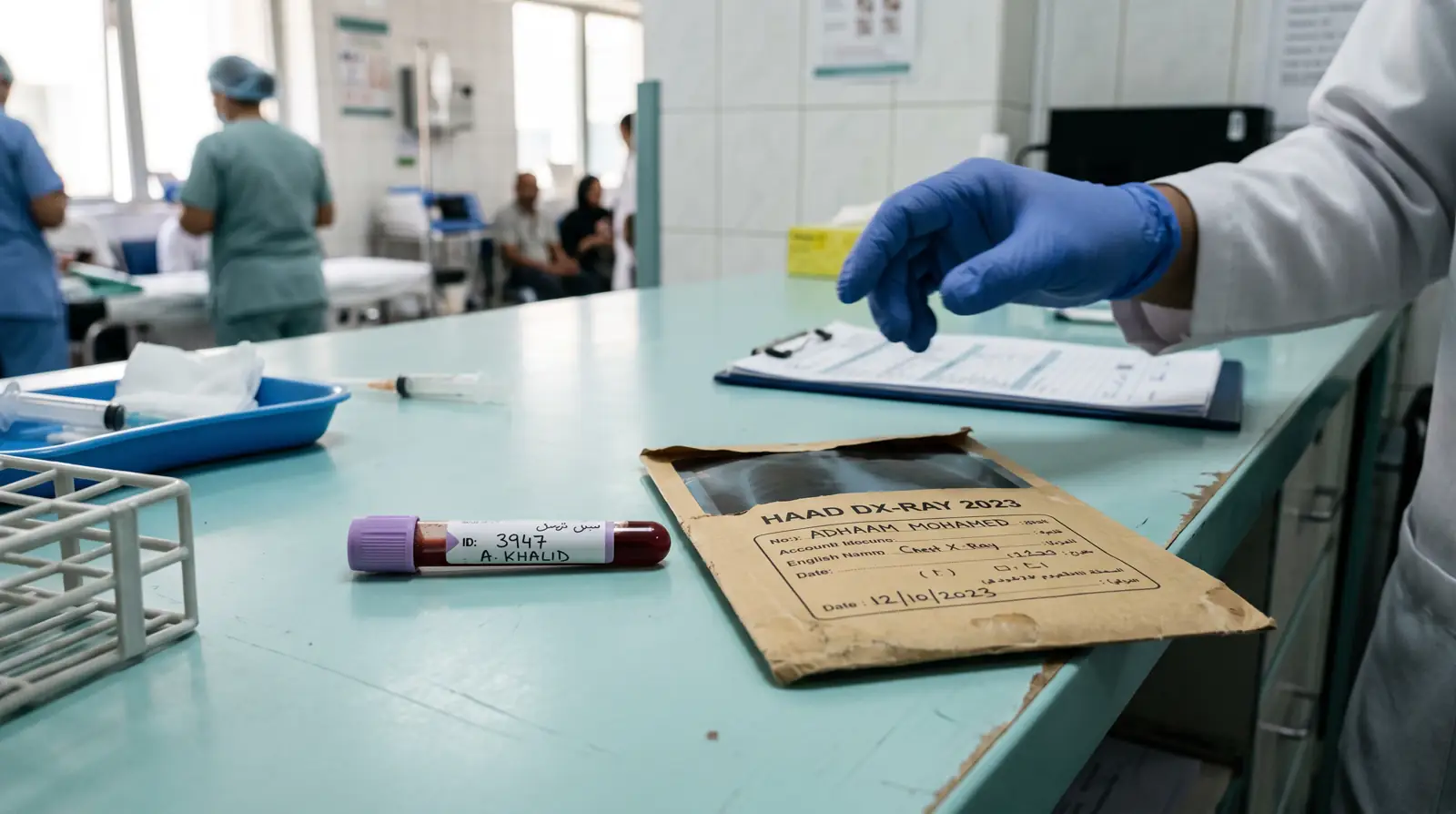
A blood collection. A chest X-ray.
That is the physical extent of it for a family dependant. No fasting requirement is published, no undressing beyond what an X-ray needs, no interview about your medical history. People arrive braced for something far more invasive than what happens.
Bring the passport, the entry permit and the application reference. The centre works from the file, so a mismatch between the name on the permit and the name on the passport stops you at reception rather than at the X-ray.
Vaccination requirements exist in the DHA framework, but they attach to specific profession categories. A sponsored spouse is not in a profession category. That part of the schedule is not about you.
What it screens for, and what it does not
Everyone screened is screened for HIV and tuberculosis.
Syphilis and hepatitis B sit in the schedule too, but they apply to specific occupational groups. Pregnancy testing applies to female domestic workers, which is a separate visa route entirely and is covered in domestic worker visas in Dubai.
What the test is not: a general health check. It will not tell you your cholesterol, it does not screen for diabetes, and a fit certificate is not a statement that you are well. It is a communicable-disease screen for residency purposes. Treat it as that and you will not be disappointed by what the report contains.
What it costs and how fast results come back
DHA's published service catalogue puts the regular medical fitness test at AED 250, with results in 24 working hours.
The number you will see quoted elsewhere is AED 320. It does not match DHA's own catalogue, and we are not going to repeat it because a hundred blogs do. Check the current schedule before you budget, because it is the kind of figure that moves.
Faster tiers exist. Dubai centres publish VIP, 24-hour and 48-hour options, and a fast-track service where staff attend an office or a home. For a family file, the regular tier is almost always the right choice, because the medical is rarely the slowest thing in your queue.
| Family member | Test needed | Cost at the regular tier | Notes |
|---|---|---|---|
| Sponsor (already resident) | Not for this file | AED 0 | The sponsor tested on their own residence, not on the dependants' |
| Spouse, 34 | Yes | AED 250 | 24 working hours |
| Daughter, 12 | No | AED 0 | Under 18 |
| Son, 19 | Yes | AED 250 | Over 18 even though still on the family file |
| Family total | - | AED 500 | Two people out of four |
What happens if the result is unfit
This is the part people are actually frightened of, so here it is plainly.
A positive TB result is not an automatic bar. DHA operates a conditional pathway: applicants with TB scars, active TB or drug-resistant TB can receive a conditional fitness certificate and a one-year visa, conditional on undergoing treatment inside the UAE.
That is a meaningfully different outcome from refusal, and it is the single most misreported fact about this test.
HIV sits differently in the framework and the consequences are more serious. We are not going to summarise a health-status rule loosely on a page people will act on. If that is your situation, get advice from a doctor and from a lawyer, in that order, and do not rely on a blog for it.
The renewal question nobody asks until year three
The medical is not a one-time event. It repeats at renewal.
Which means the twelve-year-old daughter who was exempt this cycle will be sitting the test in six years, on a renewal where nobody budgeted for it and nobody booked it. Every family we run for more than one cycle hits this at least once.
Put the eighteenth birthday of every child on the same calendar as the residence expiry. When the two land in the same year, the medical is suddenly on the critical path, and the renewal timeline you used last time no longer applies.
The wider renewal calendar is on the Dubai renewal calendar.
Four ways a dependant medical goes wrong
- Testing a child who did not need toThe most common one, and it costs money rather than time. Nobody at the counter will stop you paying for a test the rules did not ask for. Check the age first.
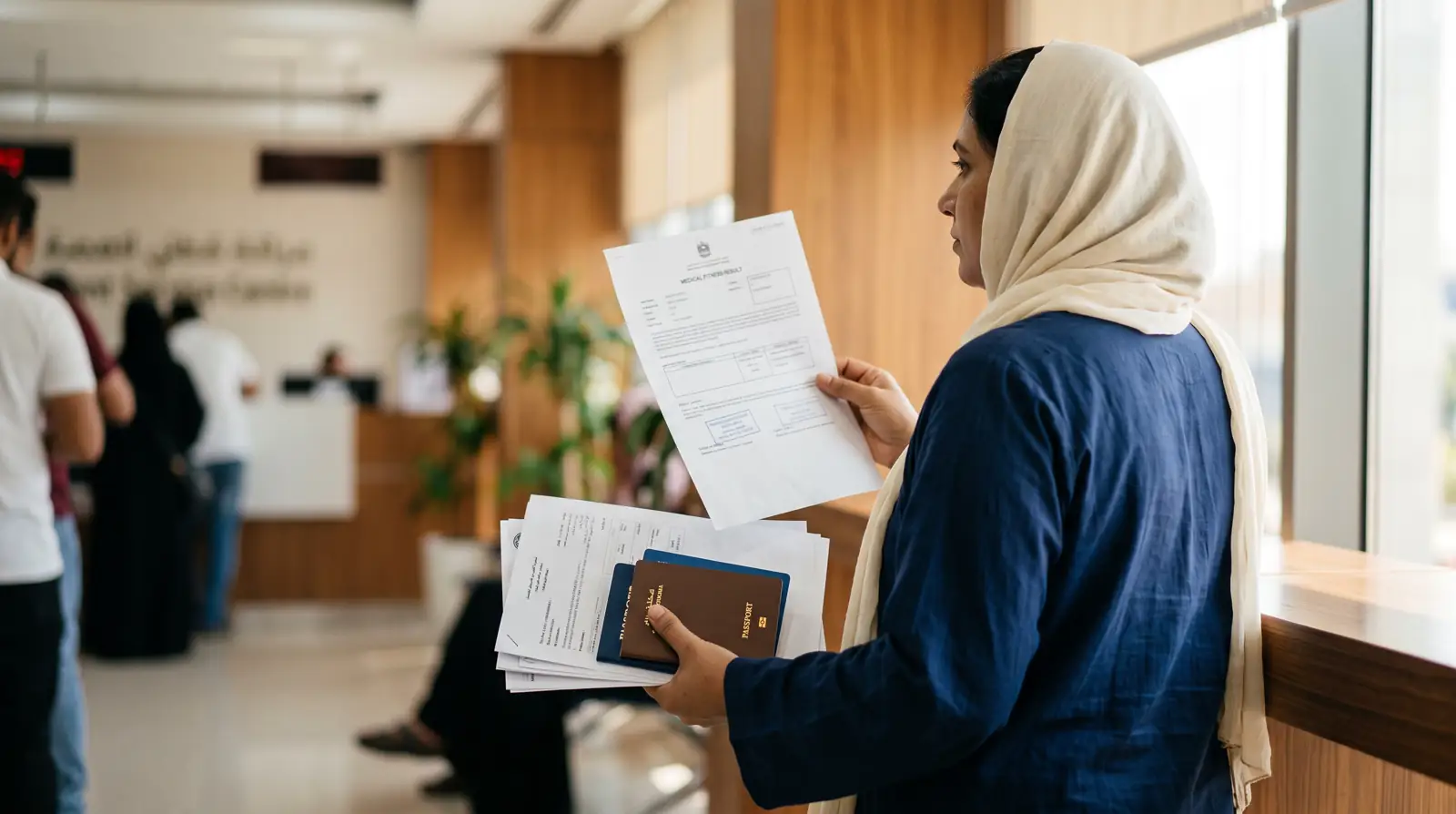
- Name mismatch between passport and entry permitThe centre works from the file. If the permit spells the name differently to the passport, reception turns you away and the appointment is gone. Fix it before you book, not at the desk.
- Booking the medical before the entry permit existsThe test attaches to an application. Without a live entry permit reference there is nothing to attach it to, and the result sits orphaned.
- Assuming the result transfers between emiratesIt is issued against a specific application in a specific emirate. A test taken for a file that was then abandoned does not carry over to a new one months later.
A worked example: a family of four
A family we filed last spring. Sponsor already resident. Wife, a son of 19 and a daughter of 12 arriving together.
The parents budgeted three medicals, because they counted three arrivals. We booked two, because the twelve-year-old is exempt. AED 250 saved, which is not the interesting part.
The interesting part was the son. He turned 19 four months before the file opened, so he needed both the medical and the biometrics, while his sister needed neither. His father had assumed "children do not do medicals" and had planned the week around two adults.
The medicals cleared in 24 working hours. The file then waited eleven days, on the wife's insurance, which had nothing to do with any of this.
That is the honest shape of it. The medical is almost never the bottleneck on a family file. It is just the step everyone worries about, while the insurance and the attested marriage certificate quietly eat the calendar. Those two are on dependant health insurance and why family files get rejected.
MSM books these alongside the rest of the file so the medical lands in the right week rather than the first one. Start at family visa services.