


A divorce in the UAE decides two things that then decide everything else.
Which law applies to you. And who has custody.
Custody decides whose residence file the children sit on, and a residence file decides where a child can live, go to school and see a doctor. So a family law question becomes an immigration question within weeks, and families are usually dealing with both at once, badly, at the worst moment of their lives.
This page is the document side. It is not legal advice, and on a matter this consequential you want a lawyer as well as a typing centre.
Which law applies to you
The UAE now runs two distinct personal status frameworks, and which one applies is not a preference you express at the counter.
Muslim couples come under Federal Decree-Law No. 41 of 2024 on the issuance of the Personal Status Law. It also applies where the husband is Muslim and the wife is not.
Non-Muslim couples come under Federal Decree-Law No. 41 of 2022 on Civil Personal Status, together with Cabinet Resolution No. 122 of 2023.
Note the asymmetry in that first rule, because it catches interfaith couples who assumed the civil law was available to them.
| Federal Decree-Law 41 of 2024 | Federal Decree-Law 41 of 2022 (civil) | |
|---|---|---|
| Applies to | Muslim couples, and where the husband is Muslim and the wife is not | Non-Muslim couples |
| Family guidance step | Mandatory. Registration with the Family Guidance Section, a counselling appointment, and an attempted reconciliation before court | Not referred to family guidance committees. Heard directly by the court |
| Custody default | Mother has first claim, then the father, then relatives | Joint custody between father and mother |
| Custody ends | At 18, continuing in special health cases | Court decides on the children's best interests |
| Child's own voice | From 15, the child may choose which parent to reside with | Weighed within the best-interests assessment |
What that choice actually changes
Three practical differences, beyond the doctrine.
Speed. The mandatory family guidance step under the 2024 law adds a stage: registration, a counselling appointment, a meeting with a counsellor, an attempted settlement, and only then referral to court. Civil cases skip that entirely. That is weeks of difference at minimum, and it lands directly on how long children sit in an unresolved residence position.
Predictability. A default of joint custody gives both parents a known starting point. A hierarchy of claims gives a different one. Neither is more certain in outcome, because courts decide on facts, but they frame negotiations differently.
The 15-year rule. Under the Sharia framework a child of 15 may choose which parent to reside with. If you have a fourteen-year-old, that is a date on the calendar, and it is worth knowing it is coming rather than meeting it.
The custody rules, side by side
Worth restating plainly, because this is the section people come here for.
Under the Sharia framework: the mother has the first claim to custody, then the father, then relatives. Custody ends when the child reaches 18, continuing beyond that in special health cases. From the age of 15, the child may choose which parent to reside with.
Under the civil framework: the default is joint custody between the father and the mother, with the court deciding according to the children's best interests.
Both frameworks separate custody from guardianship in ways that matter for paperwork. The parent a child lives with is not automatically the parent who signs for a passport, a school or a residence application. When you read a ruling, read for who holds each of those powers, not only for where the child sleeps.
What a custody ruling does to a residence file
Now the immigration consequence, which nobody explains during a divorce.
A sponsored spouse holds residence on the basis of the marriage. When the marriage ends, that basis ends. The residence does not vanish on the day of the ruling, but it is now sitting on a foundation that has been removed, and it has to be moved deliberately.
Children are the same problem with more at stake. They sit on a sponsor's file. If the sponsoring parent is not the parent they will live with, the file has to change, and the custody ruling is the document that authorises the change.
Which is why the sequence matters so much. A parent with custody but no residence of their own cannot sponsor anybody. A parent with residence but no custody may not be able to keep the children on their file. The two have to be solved together.
The order to move dependants without an overstay
The order that avoids a gap, in the common case where children move to a parent who was previously the dependant.
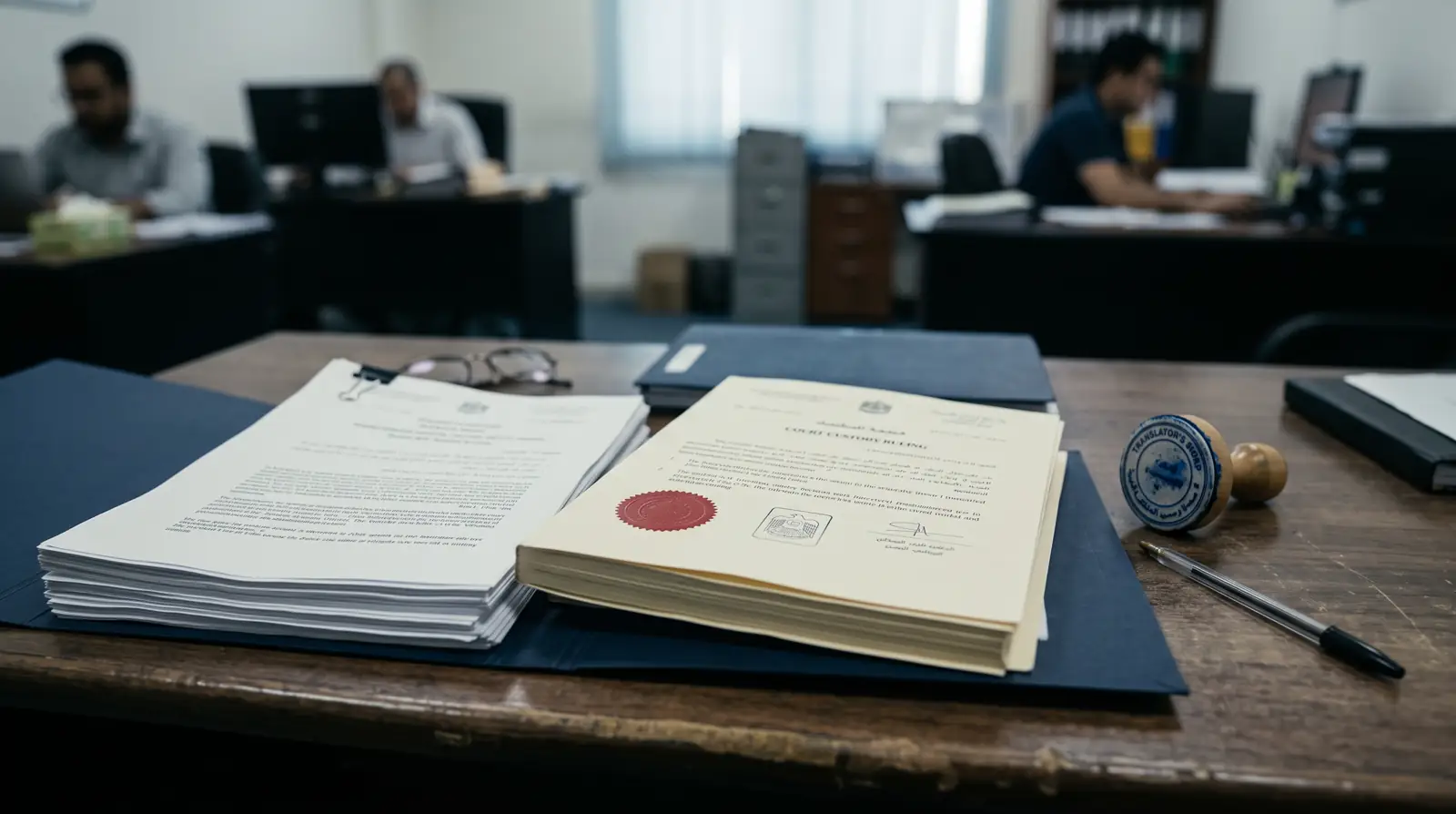
- Secure the custody ruling, attested and translatedNothing else can start properly without it. If it was issued outside the UAE it runs the full attestation chain, and if it is not in Arabic it needs legal translation. See certified legal translation.
- Establish the receiving parent's own status firstThey need a residence that can carry dependants: an employment visa, a green residency, a golden visa, or the humanitarian route below. This is the step families leave until last and it is the one everything depends on.
- Open or confirm the sponsor fileWhich means an attested Ejari lease or Dubai Land Department ownership in that parent's name. See Ejari and the housing requirement.
- Move the children, do not let them lapseCancel from the old file and apply on the new one as a planned sequence. GDRFA publishes 48 hours on both cancellation and the family entry permit, so the gap can be short if it is planned. It is long if it is discovered.
- Then close what is finishedThe former spouse's residence, insurance, the tenancy. Our guide to cancelling a family visa covers the order.
The humanitarian route, for a parent left without a sponsor
A specific and useful provision that people in this situation rarely know about.
GDRFA Dubai's humanitarian residence permit lists widowed or divorced women as a qualifying category, alongside stepchildren, wards and foster children under custody.
It grants a one-year renewable residence where there is a sponsor or host meeting the applicant's humanitarian needs, decided by committee case by case, with expected completion of 14 days.
For a woman whose residence rested on a marriage that has ended, and who has custody of children but no employment of her own, that is a route worth asking about early rather than as a last resort. The wider category list and its documents are on stepchild and adopted child sponsorship, which runs on the same permit.
Documents to secure before anything is contested
Practical, and slightly uncomfortable to write.
Documents get harder to obtain once a separation is contested. Not through anyone's malice necessarily, but because cooperation drops and because papers live in one household.
So while things are still workable, secure your own certified copies of: the marriage certificate, each child's birth certificate, both parents' passports and Emirates IDs, the tenancy contract, and any existing attestations you have paid for. Scan everything.
If any of those are unattested and you can foresee needing them, attest them now. An attestation chain requires nobody's consent. A document sitting in a home you no longer enter requires quite a lot of it.
A worked example: a separation across two countries
A situation we assisted with, details substantially changed to protect the family.
Non-Muslim couple, both resident in Dubai for nine years. Two children, ten and thirteen. Husband the sponsor, on an employment visa. Wife had not worked since the first child and had no residence of her own.
They separated in January and agreed everything except timing, which is a better starting point than most.
| Month | What happened | Status of the children |
|---|---|---|
| January | Separation agreed. Nothing filed | On the father's file, valid |
| February | Civil divorce filed, heard directly by the court with no family guidance step | On the father's file, valid |
| April | Ruling issued, joint custody, children residing with the mother | Still on the father's file, now on a basis that had changed |
| May | Mother had no residence of her own. She could not sponsor them | The problem became visible here |
| June-August | Mother obtained employment and her own residence, then a sponsor file and an Ejari | Held on the father's file by agreement while this ran |
| September | Children moved to the mother's file | Resolved |
The father kept the children on his file throughout, cooperatively, which is what prevented this from becoming serious. Not every separation has that.
What we would have done differently, and what we now say to everyone in month one: start the receiving parent's own residence immediately, in parallel with the divorce, not after the ruling. Her employment search had nothing to do with the court timetable and could have run alongside it from January.

What we tell people at the start
Four things, and we say them in this order every time.
Find out which law governs your marriage. Before anything else, because it changes the process, the timeline and the custody starting point.
Get a lawyer for the custody question. We handle documents. Custody is not a documents question, it is a legal one with lifelong consequences, and this is not the place to economise.
Start the receiving parent's residence in month one. Not after the ruling. It is the longest item and it is entirely independent of the court.
Agree the children's status separately from everything else. Whatever two adults are arguing about, a child's school place and health insurance should not be inside that argument. Most separating parents will agree to this if it is put to them as its own question.
MSM handles the document side from Deira: attestation, legal translation of rulings, cancellations and the move onto a new file. We work alongside your lawyer rather than instead of one. Start at family visa services.