



Published completion on a Dubai family entry permit is 48 hours. That is GDRFA's own number on the service card.
So when a family file sits for nine days, the honest reading is not that immigration is slow. Something on it was returned, and the notice went to a typing centre inbox nobody is watching.
We open these files from Deira every week. The reasons repeat. Almost none of them are exotic, and almost none are about the family being ineligible. They are about paper that does not match other paper.
Who you may sponsor at all is the family sponsorship guide. This page is the narrower question: the file is allowed in principle, so why did it come back?
What "rejected" actually means on a Dubai family file
Two different things get called rejection, and they cost very different amounts of time.
The first is a document return. The application is open, one item is wrong, and it waits for a corrected upload. Fees are not lost. Nobody has decided anything about your family.
The second is an actual refusal of the entry permit. The application closes. You reapply, and you pay again.
Most of what expats call rejection is the first kind. It feels like the second because the portal shows a red line and no explanation.
| What you see | What it usually is | Fees lost? | Realistic fix time |
|---|---|---|---|
| Status stuck past 48 hours, no message | Document return waiting on you | No | Same day, once you know which item |
| "Rejected" with a note naming one document | Document return | No | 1-3 days if the document exists |
| "Rejected", application closed, new application required | Refusal on a condition, usually salary, age or sponsor status | Yes | Weeks. The condition has to change first |
| Permit approved, then a problem at residence stage | Medical, insurance or Emirates ID step, not the permit | No | Days |
Find out which one you are in before you do anything else. The fixes have nothing in common.
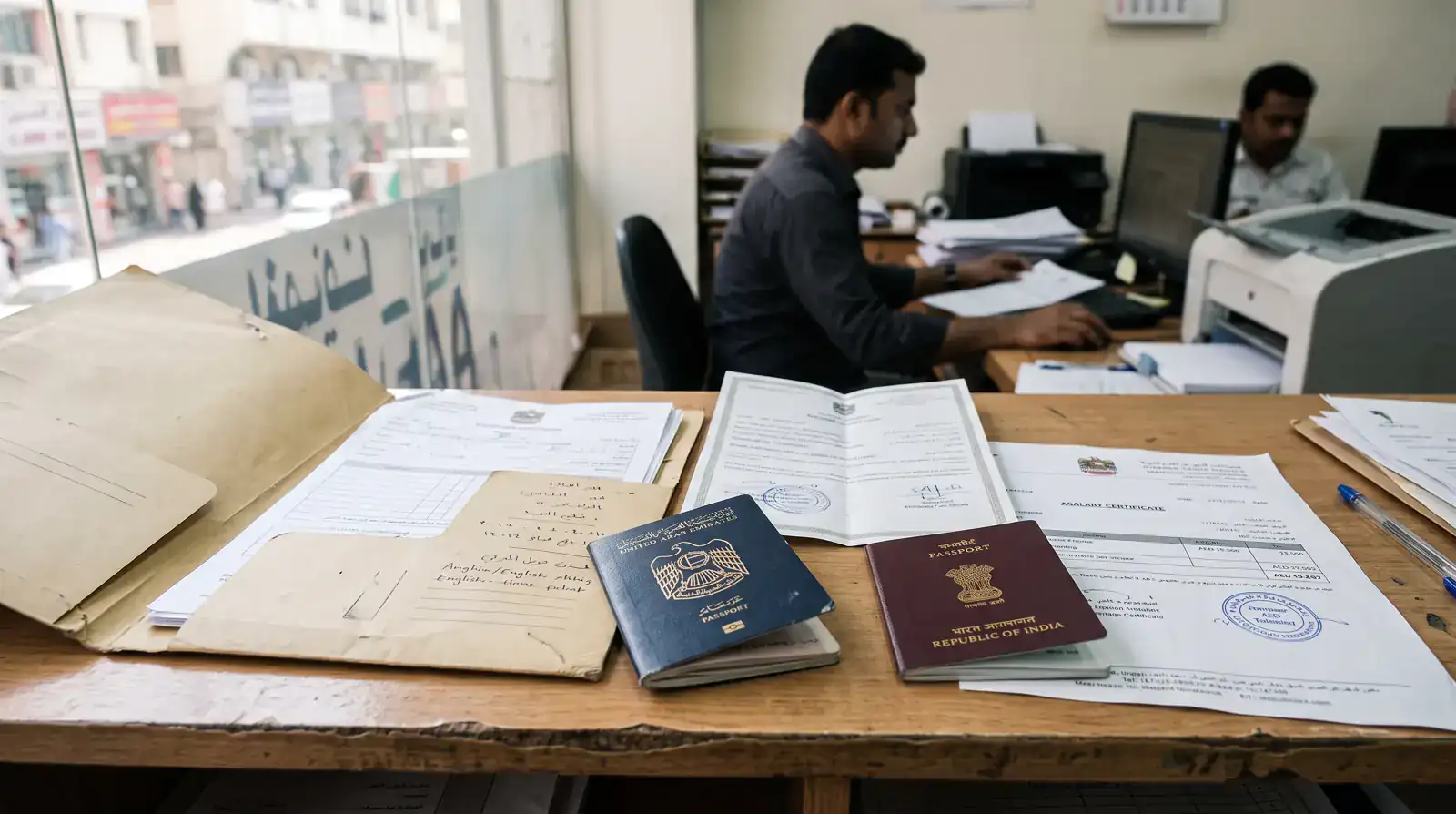
Reason 1: the salary line, and the certificate that contradicts it
GDRFA's condition is plain. The resident's salary must be a minimum of AED 4,000, or AED 3,000 plus housing.
What trips people is not the number. It is which document proves it.
The service card asks for the employment contract, and a salary certificate for government, semi-government and free zone employees. Those two papers have to agree. We see contracts stating AED 2,800 basic with allowances that carry the package past 4,000, and a salary certificate that quotes basic only. The counter reads 2,800. The file stops.
If your package is built on allowances, get the salary certificate written so the total sits on the same line as the breakdown, and get it stamped by the employer this month. A certificate from last year is a separate problem: it is stale, and a return on a stale certificate looks identical to a refusal on a low salary.
Reason 2: the marriage certificate nobody attested
The GDRFA service card lists it as "the marriage contract is certified".
Four words that cost families more time than every other item combined.
A marriage certificate issued outside the UAE is not a UAE document. It runs the attestation chain in the issuing country, then the UAE embassy there, then MOFAIC here, and if it is not in Arabic it needs a legal translation. That whole chain, started from Dubai on a certificate sitting in a drawer in another country, is comfortably four to six weeks.
People discover this the week they want the visa. That is the mistake. The marriage certificate is the one item on a family file you can finish months before you need it, and the only one where waiting costs weeks rather than days.
The chain and its fees are on certificate attestation for the UAE. Marriage certificates specifically are on marriage certificate attestation.
Reason 3: three spellings of the same name
Passport says Mohammad. Marriage certificate says Mohammed. Salary certificate says Md.
Nobody at the counter is going to decide those are the same person. They are not being difficult. A residence file is an identity record, and an identity record with three spellings is not a record.
The fix is boring and it works. Pick the passport spelling and make every other document match it. If a foreign certificate carries the wrong transliteration, correct it at source or at translation stage, before it enters the UAE chain. Correcting it after MOFAIC has stamped it means running the chain again.
Watch the surname field in particular. Naming systems without a fixed family name get split across "given name" and "surname" differently by different clerks, and the certificate ends up describing someone the passport does not.
Reason 4: the tenancy contract
People look for this on the entry permit card, do not find it, and conclude there is no housing requirement. There is one. It is on a different card.
GDRFA's Sponsor File Registration service, the step where a resident opens the file that lets them sponsor anyone at all, requires an attested lease contract issued by Ejari, or property ownership issued by the Dubai Land Department. That is the published accommodation condition, and it sits upstream of the visa application rather than inside it.
Which is why the failure feels random. The tenancy never gets questioned on the permit, because by then the sponsor file already exists. It gets questioned when the file is opened, or when it is re-examined.
So the contract must be Ejari-registered and in the sponsor's name. An unregistered contract is not the document named on the card. A contract in a brother's name is not the sponsor's accommodation, however genuinely everyone lives there.
Room count matters more than people expect on larger families. A studio with four dependants named on the permit draws attention. There is no published square-metre table we can point you to, and we are not going to invent one, but the pattern at the counter is consistent enough to plan around.
The detail is its own page: Ejari and the housing requirement.
Reason 5: a female sponsor without paternal consent
This one is on the GDRFA card in black and white, and it still surprises people every month.
Paternal consent, where the sponsor is the wife.
A mother sponsoring her own child needs the father's consent. Not because anyone doubts the relationship. Because a residence file assigns responsibility, and the father is the default responsible party unless he signs otherwise.
If the father is outside the UAE, that consent has to be a power of attorney, certified, and it travels through attestation like any other foreign document. If the parents are separated, the custody ruling goes in instead. Neither is a document you produce in an afternoon.
Reason 6: profession, when the sponsor is the wife
Here we have to be careful, because the internet is confidently repeating a figure we can no longer verify.
The number you will see everywhere is that a female sponsor needs AED 10,000 a month, or AED 8,000 plus accommodation, and a listed profession such as engineer, teacher, doctor or nurse. That rule was published on the UAE Government portal. That page has since been restructured, and the current family sponsorship page does not carry the condition at all. Neither does ICP's visa service, which sets out sponsor income thresholds in detail and states no restriction specific to women.
What GDRFA Dubai does still publish, on its live service card, is the paternal consent requirement in the section above. That one is current.
So do not budget against a figure from a page that no longer exists, and do not assume the condition is gone either. Ask GDRFA or an Amer centre what income test they will apply to a female sponsor on your profession, and get the answer before you pay anything.
The whole question has its own page: can a wife sponsor her husband in the UAE.
Reason 7: the sponsor's own visa
You cannot hang a dependant off a residence that is about to lapse.
Check three things on the sponsor before you file anything for anyone else. The residence has real validity left, not six weeks. The passport has at least six months, which GDRFA states outright on the service card. And the labour side is clean, because an unresolved status with the employer surfaces here even when nobody expected it to.
If the sponsor is mid-way through changing employer, stop. The order matters, and the wrong order puts dependants into overstay. That sequence is in changing jobs on a family visa.
Reason 8: age, on sons and daughters
The published rule is narrower than the folklore.
An expatriate sponsor may bring unmarried daughters, sons under 25, and children with special needs. GDRFA's own card puts male children at up to 25 for residents.
Two consequences people miss. A daughter's eligibility turns on marital status, not age, and a marriage abroad that was never registered here still ends the sponsorship. And a son at 25 does not get an extension for studying, unless the file moves to a student route, which is a different application with different paper.
What happens at 18 and at 25 is covered here. The daughter rule and its limits are on sponsoring an unmarried daughter.
Reason 9: medical and insurance
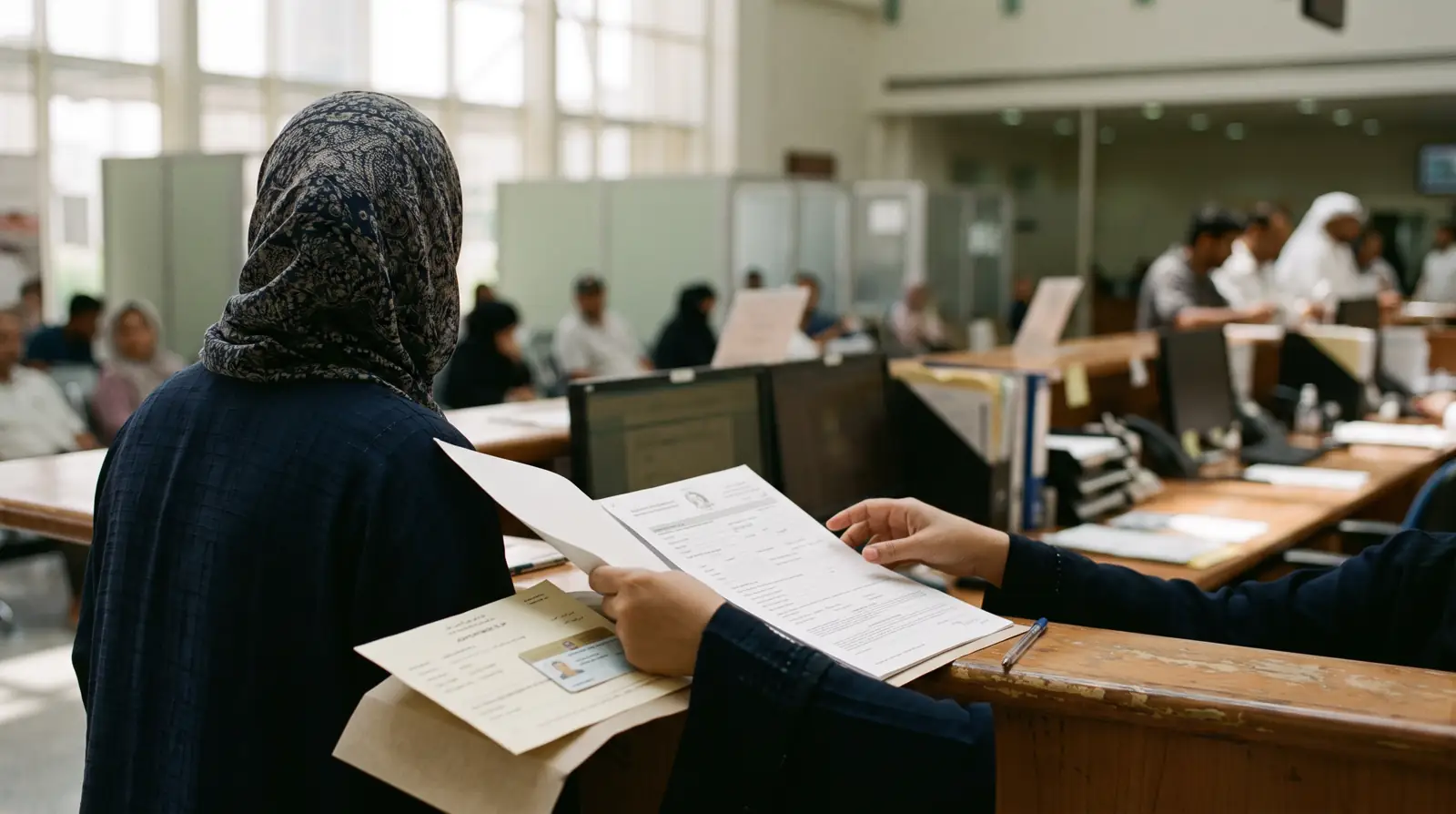
Family members who have completed 18 years undergo and must pass a medical fitness test at an approved centre. Under 18, no test.
That one line resolves most of the panic we hear. If a portal shows a medical problem against a nine-year-old, it is a record attached to the wrong person, not a diagnosis. Take the reference number to the centre and have it traced. Do not repeat the test.
Insurance is the other residence-stage blocker, and in Dubai it is a hard one. Cover has to be in place for the dependant before residence completes. What counts, and who is legally responsible for buying it, is in health insurance for dependants.
Who sits the medical, who is exempt and what the result screens for is on the dependant medical test.
A worked example: the file we fixed twice
A file we ran last year, with the numbers changed and the shape intact.
Sponsor on AED 4,200 total: AED 2,800 basic plus allowances. Wife and one child. Marriage certificate from the home country, never attested. Tenancy in the brother's name.
First attempt, returned. The salary certificate quoted basic only, so the counter saw AED 2,800 against a 4,000 line.
Second attempt with a corrected certificate showing the full package: returned again, this time on the marriage contract. That chain took twenty-six days, because the certificate had to leave the country and come back.
Third attempt cleared in two days.
| Attempt | What was wrong | Cost of the round | Days lost |
|---|---|---|---|
| 1 | Salary certificate quoted basic salary only | Document return, no new fee | 9 |
| 2 | Marriage contract not certified | Document return, no new fee | 26 |
| 3 | Nothing | Normal fees | 2 |
Thirty-seven days, and the only item that ever needed real calendar was the marriage certificate. Everything else was a same-week fix, discovered late because it was discovered one at a time.
That is the pattern. Files are not returned once for one big reason. They are returned three times for three small ones, in series, because nobody audited the folder before the first submission.
What to do the day it is refused
Four things, in this order.
- Get the actual reason in writingNot a screenshot of a red status. Ask the typing centre or Amer for the note, and ask which specific document it names. Everything else is guessing.
- Establish which category you are inDocument return, or closed refusal. If fees were consumed and the application number is dead, it is the second, and the condition has to change before you refile.
- Audit the whole folder, not the named itemThe named item is simply the first one the system reached. Fixing only that reliably produces a second return on the next one down. Check salary proof, marriage contract, birth certificates, name spellings, sponsor validity and consent in one pass.
- Refile once, completeTwo clean attempts beat five partial ones, and nobody at the counter is keeping score of your patience.
One more thing worth saying plainly. A returned family file is not a judgement on your family and it does not go on a record that follows you. It is a queue rejecting a mismatch. Treat it as clerical, because it is.
MSM files these from Deira. Send us the note and the folder, and we will tell you in a day which items are real and which are noise. Start at family visa services.