


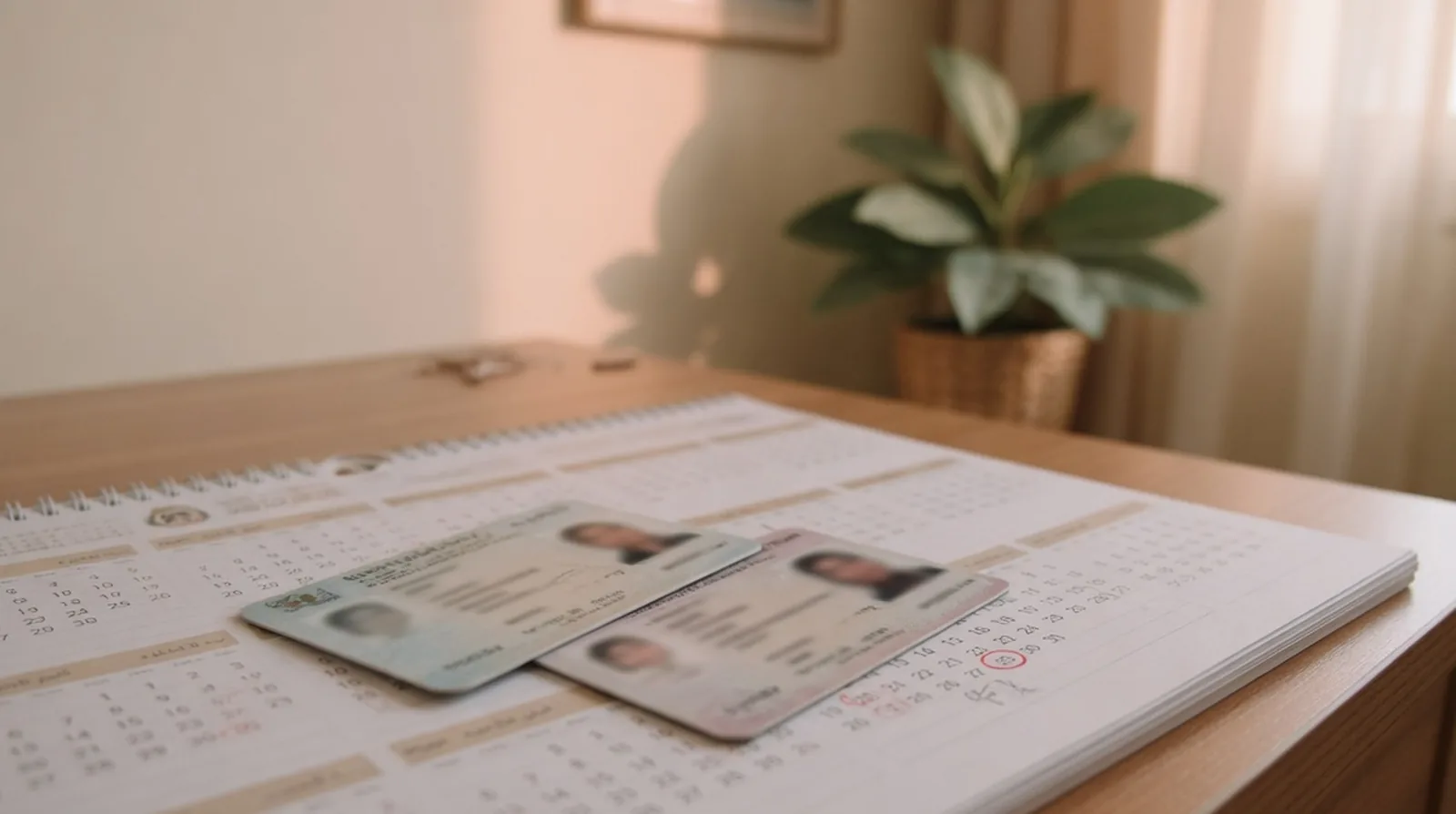
The child's Emirates ID expired in March. Yours is valid until November.
That six-month gap is the fine we see charged on family files. Not a forgotten adult card. A child's card that nobody put in the calendar, because it does not share an expiry with the sponsor.
Every resident child needs an Emirates ID. The card is issued with the residence visa, it dies with that visa, and the dates on it will not match yours unless you issued both on the same day. Who can sit on the family file is the family sponsorship guide. This page is the card.
When does a child need an Emirates ID in the UAE?
The UAE Government portal is blunt. Emirates ID is a legal requirement for every citizen and every resident. You apply for one. You carry it.
A child on a parent's residence is a resident. The card is not optional, and it is not a copy of yours. ICP issues it against the child's own file, with the child's photograph and the child's visa dates.
Three situations, one obligation.
- Born here. Birth certificate, then a passport from your mission, then the residence visa, then the ID. The ID is last because each document is evidence for the next.
- Brought in on a family visa. The ID is applied with the residence. ICP's own residency card describes the permit as linked to an Emirates ID application.
- Already here, card running out. Same renewal rules as an adult card, on the child's own expiry date.
Since 2022 the residence permit lives on the Emirates ID rather than a passport sticker. An expired child's card is therefore expired proof of that child's residence. Banks and government counters treat it that way.
How long do I have after my baby is born?
Two clocks, and they are not the same instrument.
The government portal's having-a-baby page, updated 11 February 2026, gives residents 120 days from the birth to arrange the birth certificate, the passport, the residence visa and the Emirates ID. Separately, that page gives you 30 days to register the birth itself.
ICP's new-identity-card service is more specific about the card. For a foreigner whose child is born inside the country, the ID late fine is calculated after four months from the date of birth. Four months is roughly 120 days. The two official pages are pointing at the same window.
Start the birth certificate in the first week. Everything else waits on it. A UAE-issued certificate is quick. A foreign one is not, because it needs the full attestation chain before anyone will look at the visa.
If the child was not born here, the four-month-from-birth ID fine does not apply. That sentence on ICP's card is for a birth inside the country. An inbound child gets the ID with the residence file, inside the window GDRFA gives you after entry.

Does my child need fingerprints, and from what age?
Fifteen. Not eighteen. Not five.
The government portal and ICP both require fingerprint and signature procedures once the person has completed 15 years of age. That includes a first card and a renewal. Under 15, there is no biometric appointment.
In practice we do not take under-15s to the ICP counter for fingerprints. A recent personal photograph is still required. ICP's published photo standard is the ICAO one: white background, face straight, eyes clear, no hat, no sunglasses, only medical glasses if they do not hide the eyes, expression neutral.
School students aged 15 and above can have ten fingerprints taken at school under ICP's Basmah 15 programme. If that already happened, the next centre visit is still required when the card itself is issued or renewed. Basmah 15 captures the prints. It does not print the card.
What does a child's Emirates ID cost?
ICP publishes the resident card at AED 100 per year of residence, plus a AED 100 smart service fee. The fee follows the visa length. It is not a flat children's rate.
| Case | Biometrics | Published fee | Deadline | Late fine |
|---|---|---|---|---|
| Newborn (born in the UAE) | No | AED 100 per year of residence + AED 100 smart | Four months from birth (ICP). 120 days for the document bundle (u.ae). | AED 20 per day after four months, capped at AED 1,000 |
| Child under 15 | No | AED 100 per year of residence + AED 100 smart | With the residence application. Then the card's own expiry. | First issue, if born here: the four-month ID fine. Later: the renewal fine. |
| Child 15 and over | Yes. Fingerprint and signature at an ICP centre. | AED 100 per year of residence + AED 100 smart | With the residence application, plus a centre visit. | Same two fines, depending on first issue or renewal. |
| Renewal | Yes if 15+. No if under 15. | AED 100 per year of residence + AED 100 smart. Urgent AED 150 at a centre. | Window opens when less than six months remain (residents). Fine after 30 days from expiry. | AED 20 per day, capped at AED 1,000. Detail in the renewal article. |
A one-year visa is AED 200 for the card side. Two years is AED 300. Three years is AED 400. The smart fee does not multiply.
UAE national children under 21 pay AED 100 for a five-year card. Citizens aged 21 and over pay AED 200 for a ten-year card. Emirati newborns can take the Mabrouk Ma Yak bundle, which includes the ID. The rest of this page is for resident families.
Urgent 24-hour service is AED 150 and is collected in person. For expatriate residents other than GCC nationals, the portal restricts that urgent route to replacement cards. A baby's first card is standard service. ICP publishes completion at five days.
What is the late fine on a child's first card?
On the card itself, ICP is unambiguous. After four months from a birth inside the country, the late fine is AED 20 per day, not exceeding AED 1,000.
That is the ID fine. The visa has a different line and a different daily rate, and the published figures for that line do not currently agree with each other. Do not budget the ID against a visa number you read on a forum.
Take a baby born on 1 March. The four-month mark is 1 July. The sponsor has two years of residence left, so the published card fee is AED 200 plus AED 100 smart, AED 300.
- Filed on 15 June: ID fine AED 0. Card AED 300. Total on the ID side: AED 300.
- Filed on 31 July, 30 days late: ID fine AED 600. Card AED 300. Total: AED 900.
- Filed on 20 September, 81 days late: 81 × 20 is AED 1,620, but the cap is AED 1,000. Fine AED 1,000. Card AED 300. Total: AED 1,300.
The cap is real. After 50 late days the ID fine stops growing. The visa fine is a different line and does not use this AED 1,000 ceiling. If both are running, clear the visa side first.
Once the first card exists, late renewal is a different rule: 30 days after expiry, then AED 20 a day, same AED 1,000 ceiling. That regime, including who is exempt, sits in Emirates ID renewal and the daily fine. This page does not repeat it.
Why do the child's card and my card expire on different dates?
Because the child's visa was issued later than yours.
Your card started on the day your residence was issued. The child's card started on the day theirs was. A baby born in June, visa stamped in August, holds a card that starts in August and dies on whatever end date was printed on that permit. That date is not yours unless both files were issued the same day. It is not November just because November is when you renew.
The other way the dates split: you renew your own visa and ID as one job, and nobody opens the child's wallet. The child's remaining months keep running. Then they stop. Then the 30-day grace runs out. Then the fine starts, on a card you have not looked at since the courier dropped it off.
We would rather you keep two calendar entries than try to force the dates together. Aligning them means holding the child's file until your own renewal, which is how a four-month first-issue clock, or a 30-day renewal clock, gets missed. The trade-off of treating them as two files is one extra typing job this year. The trade-off of treating them as one is a fine you only discover when the school asks for the card.
How do I apply for a child's Emirates ID?
The order is fixed. Skipping a step does not save time. It restarts the file.
- Get the birth certificate firstResidents have 30 days to register a birth in the UAE. A UAE-issued certificate is the fast route. A foreign one needs the full attestation chain before anyone will look at the visa.
- Get the child's passportFrom your own embassy or consulate here. Their timeline is outside ICP and GDRFA, and it is usually the step that decides whether 120 days feels comfortable or tight.
- File the residence visaSponsored by the parent who holds the qualifying residence. You will need the attested kinship proof, the sponsor's passport and Emirates ID, and the papers in the family visa document list.
- File the Emirates ID with that visaICP treats the residence and the ID as linked. Apply through ICP Smart Services, the UAE ICP app, or an accredited typing centre, signed in with UAE PASS. Do not wait for a later "ID appointment".
- Attend for biometrics only if the child is 15 or overFingerprint and signature at an ICP Customer Happiness Centre. Under 15, submit the photograph with the application and stop there.
- Wait the published five daysStandard service. A first-issue card for most expatriate residents is not eligible for the 24-hour urgent route. Track the application on the ICP site with the number that starts 010.
Which file gets bounced most often?
The photograph.
At the typing desk the first thing we open is the image, not the passport. A six-week-old on a cream blanket, a parent's thumb in the corner, eyes closed, or a filter still on the phone file, comes back the same day. ICP's own standard is the ICAO one listed above. Get it done at a studio that shoots Emirates ID photos, not on the sofa.
Two other files we see returned.
The name does not match. The birth certificate used one transliteration. The passport used another. The ID application will not "know what you meant". Fix the spelling before you pay.
The ID is filed before the visa exists. ICP's new-card service depends on the residence permit. Applying for the card against a birth certificate and a hope does not work. Wait for the visa file to be live, then file both.
ICP's new-card list for a relative of a resident foreigner is short: the child's passport and photograph, the resident's valid passport and Emirates ID, and attested first-degree kinship proof. That last item is the birth certificate. Have those in the same folder. Everything else is supporting.
And do not take the file to Amer for fingerprints. Amer serves GDRFA. Prints are ICP. We have watched a parent lose a morning in the wrong building with a 16-year-old who only needed a five-minute slot at a Customer Happiness Centre.
What changes when my child turns 15?
The next application needs a centre visit. The 15th birthday itself does not.
ICP repeats fingerprint and signature from 15 up, on new issue and on renewal. If the child already enrolled through Basmah 15 at school, the prints exist. They still attend when the card is actually issued or renewed.
Do not mash this together with the 18th birthday. Eighteen is the medical, on the visa file, at the next issuance or renewal. Fifteen is the ID biometric. A household that still thinks "they go in at 18" books a slot for a 13-year-old who does not need one, and then skips the 16-year-old who does.
Count from 15. Put that date next to the card expiry. Those are the only two numbers that matter on a child's Emirates ID. If a trip abroad is coming and only one parent is travelling, the consent question is on travelling abroad with a child.
MSM files children's first cards and renewals through ICP and the typing channel, including the biometric booking once they are 15. See Emirates ID services.