



Nine routes, four authorities, and a search results page full of consultancies quoting numbers that were true in 2022. That is the actual difficulty with UAE residence visas: not the process, but working out which door you are supposed to walk through.
This guide sorts them by who qualifies and what proof each one wants, with every threshold traced to the authority that publishes it.
How the UAE residence system is actually organised
Two families of visa, and the split explains almost everything.
Sponsored. Somebody else is responsible for you: an employer, a spouse, a parent, a company. The UAE Government portal states these run one, two or three years. Your status is tied to the sponsor, and cancelling their file starts a clock on yours.
Unsponsored. You hold the residence in your own right. Five or ten years depending on the route, no employer needed, and you can sponsor your own family. Golden, Green, Blue and retirement visas all sit here.
The unsponsored routes are the ones worth ten minutes of your time, because plenty of people already qualify for one and are still renewing a two-year employment visa out of habit.
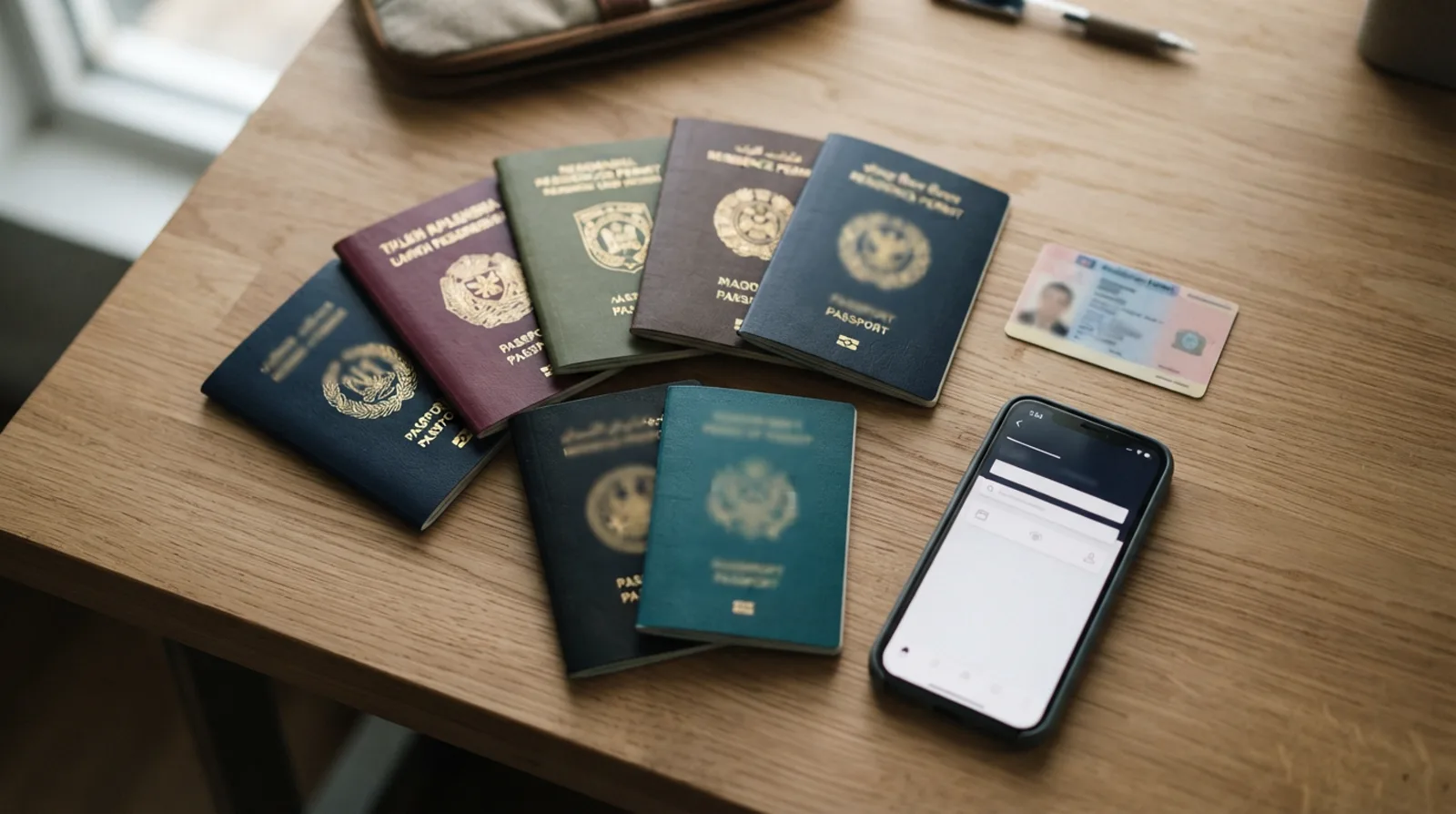
Employment visa: the default route
The route most residents arrive on. The employer initiates it, and the standard work residence visa is valid for two years and renewable.
It runs through MoHRE and then immigration: job offer, work permit, entry permit, medical fitness, Emirates ID biometrics, residence issuance. A work permit to recruit from outside the UAE is valid for two years.
Two timing rules matter, and both are 60 days. You must enter the UAE within 60 days of the entry permit being issued. Then you have 60 days from the date of entry to complete the residence formalities. Blow through the second window and the overstay fine starts at AED 50 per day. The full sequence is in our UAE employment visa process guide.
Family sponsorship: the second most common route
A resident can sponsor a spouse and children. Three official sources — the government portal, ICP and GDRFA Dubai — agree on the salary test: AED 4,000 a month, or AED 3,000 plus accommodation.
Who counts as a child: the spouse, unmarried daughters with no age limit, sons under 25, and children with disabilities regardless of age. Dependants aged 18 and over must pass a medical fitness test.
You will need an attested tenancy contract, a recent electricity and water bill, an attested birth certificate for children and a certified marriage contract for a spouse. If those certificates were issued abroad, they need the full attestation chain first, which is the step that adds weeks. See certificate attestation for the UAE.
Sponsoring parents is a different and stricter case. GDRFA Dubai publishes a minimum salary of AED 10,000 for the sponsor, an attested tenancy contract sized for the family, three months of bank statements, and a financial guarantee of AED 5,000 per request capped at AED 15,000. Sponsoring siblings requires the parents to be sponsored first, except after a death or divorce.
Salary and housing tests are unpacked properly in family visa salary requirements in Dubai, and the document list in our family visa documents guide.
Golden visa: 10 years, no sponsor
Ten years, no sponsor, and family sponsorship for spouse and children regardless of age. ICP publishes the federal category list.
The headline routes: public investment of no less than AED 2 million, or an establishment paying annual tax of at least AED 250,000. Real estate ownership from AED 2 million. Entrepreneurs with an auditor letter proving a project value of at least AED 500,000. Executive directors on a salary certificate of at least AED 50,000 with a degree and five years of experience. Doctors, scientists, inventors, creatives and athletes, each nominated by the relevant ministry or council.
Students qualify too: 95% or above at secondary level, or a university GPA of 3.8 at an accredited institution within two years of graduating.
One genuine complication, and it is worth knowing before you apply. On the property route, ICP says AED 2 million without loans and grants five years. GDRFA Dubai and the Dubai Land Department both say a mortgaged property is acceptable, with a bank no-objection letter, and grant ten years. Both are official. Both are current. For a Dubai file, the GDRFA and DLD position is the one that governs, and DLD publishes its own fee total of AED 9,884.75 with seven to ten business days processing.
Every route and its evidence is set out in UAE Golden Visa eligibility. Our Golden Visa service page covers how we file it.
Green visa: 5 years, self-sponsored
The most underused visa in the country, and the one that fits a lot of people reading this.
Five years, renewable, self-sponsored, and you can sponsor your spouse and children. Three tracks:
| Green visa track | What you need |
|---|---|
| Skilled employee | A valid UAE employment contract, MoHRE skill level 1 to 3, a bachelor's degree minimum, and a monthly salary of at least AED 15,000 |
| Freelancer or self-employed | A MoHRE freelance or self-employment permit, a degree or specialised diploma, and annual income of at least AED 360,000 across the past two years or proof of financial solvency for the residency period |
| Investor or partner | Proof of investment or partnership in a UAE project with all required licences and approvals. ICP publishes no capital threshold for this track |
Read that freelance row again. The AED 360,000 income test has an or in it. Proof of financial solvency across the residency period is an accepted alternative, and almost no guide mentions it. If your income is lumpy but your balance sheet is not, that clause is the one to build your file around.
Note also that the commonly quoted AED 500,000 figure for the investor track appears on commercial sites, not on ICP. If someone quotes it to you as a rule, ask where it is published.
Remote work visa: one year, employer abroad
For people employed by a company outside the UAE who want to live here legally while doing that job.
One year, self-sponsored. The requirement is a salary certificate of a minimum of USD 3,500 a month or the equivalent, plus health insurance, a medical fitness test and documentation proving the work is performed outside the UAE.
It is genuinely straightforward. The catch is duration: one year, and the government portal does not publish renewal terms, so plan the second year rather than assuming it.

Freelance and self-employment
Worth untangling, because three different things share the word "freelance" and they are not interchangeable.
- A freelance work permit from MoHRE. An employment-law instrument. Article 6 of Federal Decree-Law 33 of 2021 makes it illegal to work in the UAE without a MoHRE work permit, and this is the permit that covers working independently without an employer sponsor and without an active employment contract.
- A freelance licence from a free zone. A trade licence issued to you as a natural person.
- An e-Trader licence from Dubai's DET. Home-based, sole individual, no office or staff, and nationality-restricted.
You may need the permit and the licence, not one or the other. Getting that wrong is one of the more expensive misunderstandings in this market, because a licence without a work permit does not make the work lawful.
Job seeker, retirement and Blue visas
Three routes that get less attention than they deserve.
Job seeker visa. No host or sponsor. Choose 60, 90 or 120 days, single entry. You need to be in MoHRE skill level 1, 2 or 3, or a graduate of a top-500 university worldwide within the last two years, with a bachelor's degree and a financial guarantee.
Retirement visa. Five years, from age 55, with at least 15 years of work behind you. The federal test is property of at least AED 1 million and savings of at least AED 1 million, or an annual income of at least AED 180,000. Dubai's own card sets the income route higher, at AED 240,000 a year with six months of bank statements, and accepts a mortgaged property where the equity is at least AED 1 million.
That federal and is not a typo. The property route requires both the property and the savings, which is the opposite of how most articles describe it.
Blue visa. Ten years, for exceptional contribution to environmental protection and sustainability. Open to Emiratis and residents, by direct application to ICP or by nomination. Barely covered anywhere, and a live product on ICP's fee schedule.
Comparison table: which one fits you
| Route | Length | Sponsor | Headline threshold |
|---|---|---|---|
| Employment | 2 years typically | Employer | A job offer and a MoHRE work permit |
| Family sponsorship | Tied to sponsor | Resident family member | AED 4,000/month, or AED 3,000 plus accommodation |
| Golden:investor | 10 years (Dubai) | None | AED 2m property, or AED 2m public investment |
| Golden:executive | 10 years | None | AED 50,000 salary certificate, degree, 5 years experience |
| Golden:entrepreneur | 5 years (ICP) | None | Auditor letter, project value from AED 500,000 |
| Green:skilled employee | 5 years | None | AED 15,000/month, degree, MoHRE level 1 to 3 |
| Green:freelancer | 5 years | None | AED 360,000/year over 2 years, or proof of solvency |
| Remote work | 1 year | None | USD 3,500/month from an employer abroad |
| Retirement (55+) | 5 years | None | AED 1m property and AED 1m savings, or AED 180,000/year |
| Job seeker | 60/90/120 days | None | MoHRE level 1 to 3, or top-500 graduate |
The rules that catch people out
Four rules that quietly decide outcomes.
The 180-day rule. An ordinary residence visa is automatically nullified by 180 continuous days outside the UAE. Golden visa holders are exempt from the usual limit. If you travel heavily and hold a standard visa, this is the single most important sentence in this article.
Return after a long absence. Absence beyond six months attracts AED 100 for each 30 days or part of it, payable to obtain a return entry permit.
The dependant grace period. When a sponsor's permit expires or is cancelled, dependants get a six-month grace period.
Status change costs AED 500. Moving from one status to another inside the country carries a government status amendment fee of AED 500 plus small knowledge and innovation dirhams, processed in 48 hours through GDRFA smart services or an Amer centre. Conditions: you must have a new visa, and the previous residence permit must be cancelled. See UAE visa change.
MSM files residence applications through GDRFA Dubai and ICP every week and can tell you in one conversation which routes you actually qualify for. Send your salary band, your role and your qualifications. Start at visa services.