



An offer letter is not a visa. Between the signature and the residence permit sit seven stages, two authorities and two hard 60-day deadlines, and the deadlines are the part that costs money.
Here is the whole sequence, with the published durations at each step.
The seven stages
| # | Stage | Authority | Rule or duration |
|---|---|---|---|
| 1 | MoHRE job offer and work permit | MoHRE | Work permit to recruit from outside the UAE is valid 2 years |
| 2 | Entry permit | ICP or GDRFA | Must enter within 60 days of issuance |
| 3 | Entry, or in-country status change | ICP or GDRFA | Status amendment fee AED 500, processed in 48 hours |
| 4 | Medical fitness test | Dubai Health / approved centres | Inside the 60-day post-entry window |
| 5 | Emirates ID application and biometrics | ICP | In person for anyone over 15 |
| 6 | Residence visa issuance | ICP or GDRFA | Electronic. No passport sticker since 2022 |
| 7 | Tawjeeh session, where applicable | MoHRE | Before contract approval, mainland skill levels 3 to 5 |
Nothing in this chain can start until the company has its establishment cards. That is a separate prerequisite covered in establishment card and labour file.
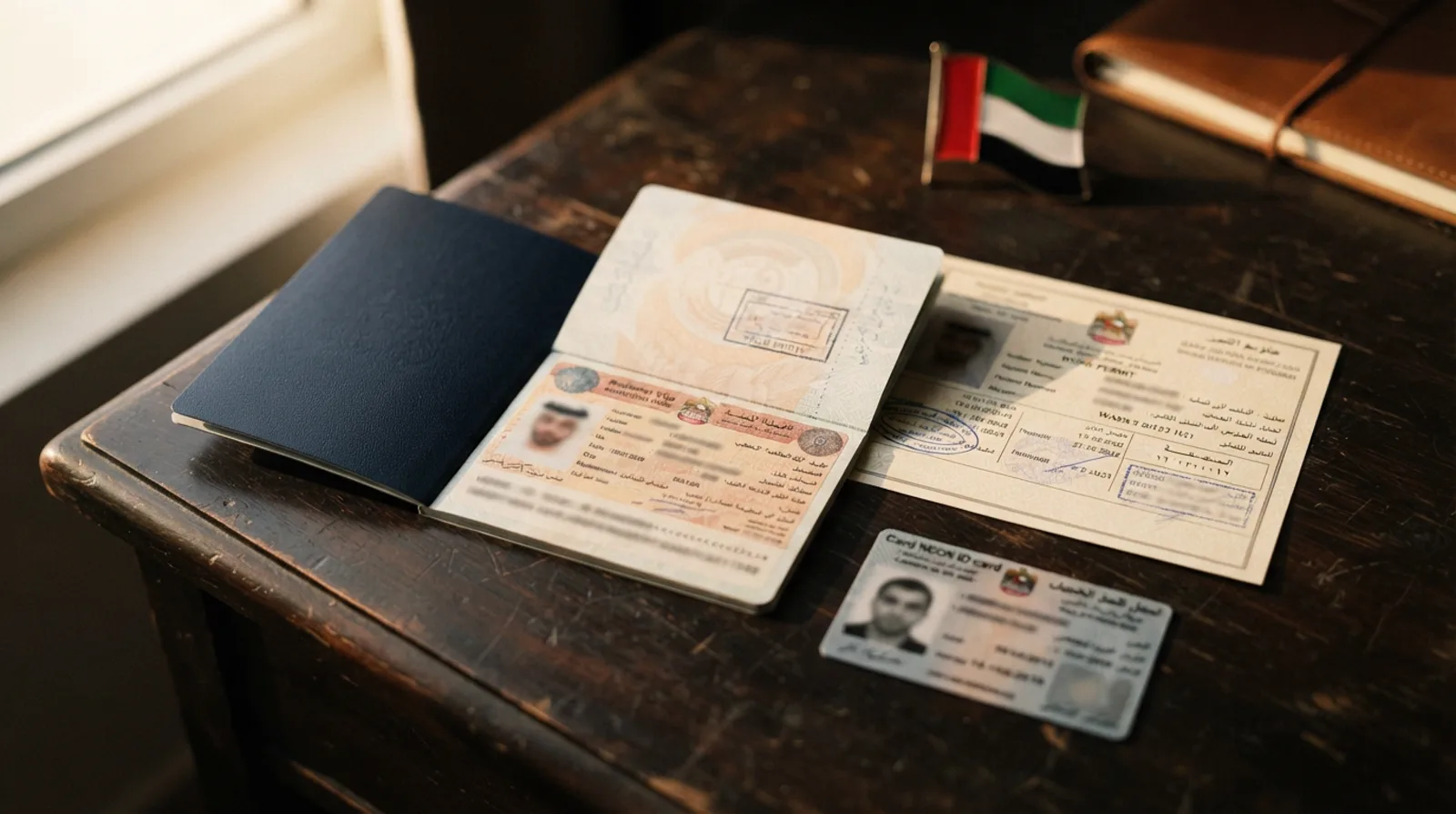
Stage 1: offer letter and work permit
MoHRE approves the role against the company's labour file and quota. The offer letter is registered, then the work permit issued.
Work permit fees are set by the company's classification and run from AED 250 to AED 3,450, per the UAE Government portal. That is a wide range and it is driven by the employer's category, not by the employee.
MoHRE issues 13 work permit types. One of them, the private tutoring permit, is free. A work permit to recruit from outside the UAE is valid for two years, as are transfer permits and family-sponsorship work permits.
Worth being clear about a legal point people skip: Article 6 of Federal Decree-Law 33 of 2021 makes it illegal to work in the UAE without a MoHRE-issued work permit. That applies to freelancers too, which is why a free zone freelance licence alone does not make the work lawful.
Stage 2: entry permit, and the first 60-day clock
Once the work permit is approved, the entry permit is issued.
ICP states the rule verbatim: "The holder must enter the UAE within the 60-day validity period of the entry permit from its date of issuance."
Sixty days sounds generous. It stops feeling generous when the employee is serving a notice period abroad, waiting on an attestation, or has a passport at another embassy. If any of those apply, sequence the entry permit late rather than early.
Stage 3: entering, or changing status in-country
Two routes in, and they cost differently.
Entering from outside. The employee flies in on the entry permit. Clock two starts on the date of entry.
Changing status in-country. For someone already in the UAE on another status. GDRFA Dubai publishes the fee lines: AED 500 registration plus AED 10 Knowledge Dirham, AED 10 Innovation Dirham, and AED 15 individual or AED 50 establishment. ICP states the federal status adjustment fee as AED 500 too. Processed in 48 hours, through GDRFA smart services or an Amer centre.
GDRFA lists two conditions for a status change: "having a new visa" and "cancellation of the previous residence permit." Documents: passport copies for both the sponsored person and the sponsor, the sponsor's residence permit copy, the cancelled entry or residence permit, and the new entry permit.
Stage 4: medical fitness
Blood screening and a chest X-ray at an approved centre. The Dubai Health published fee for the regular medical fitness test is AED 250.
That figure is worth stating plainly, because AED 320 is repeated across the internet as the standard rate and it does not match Dubai Health's own published figure.
Express and VIP tiers exist at higher prices and shorter turnaround. Whether they are worth it depends entirely on whether the medical is your critical path, which it usually is not. Full detail in the Dubai medical fitness test.
Stage 5: Emirates ID and biometrics
The Emirates ID application can be submitted online through ICP Smart Services or the UAE ICP app. Biometrics cannot.
ICP is explicit that biometrics and signature capture require a physical visit for anyone over 15. In Dubai that means an ICP Customer Happiness Centre, of which there are seven: Al Barsha, Al Ghazal, Al Rashidiya, Al Nahda, Al Yalayis, Al Baraha and Hatta.
This is the stage that most often slips, because it needs the employee to physically be somewhere during working hours. Book it the day the medical is done. See biometrics for UAE residency.

Stage 6: residence visa issuance
The permit is issued electronically. There has been no physical visa sticker in UAE passports since 2022, which is worth knowing because articles still describe "stamping" as a step.
The standard work residence visa is valid for two years and renewable, and the employer must initiate it. Sponsored visas generally run one, two or three years; unsponsored routes such as Golden and Green run five or ten. ICP's own phrasing is "one year, two years, three years, and may extend to five years or more for some categories."
One caveat worth flagging: the widely repeated claim that free zones issue three-year visas while mainland issues two is not stated anywhere official. The government portal confirms 1, 2 and 3-year sponsored visas exist. It never says who gets which.
Stage 7: Tawjeeh, where it applies
Tawjeeh is a MoHRE labour-law awareness session delivered before the employment contract is approved.
It applies to new employment residence permit applicants in selected professions, specifically skill categories 3, 4 and 5 on the mainland. Free zone workers are outside it. The requirement dates from 2018.
Format is roughly a 90-minute classroom session with a video, delivered in sixteen or more languages including Hindi, Urdu, Bengali, Tagalog and Malayalam, covering UAE labour law, ministerial resolutions, labour market regulations and cultural values. The contract is issued on completion.
On the fee: MoHRE does not publish one. Circulating figures range from AED 154 to AED 203 and disagree with each other. Ask the centre in writing.
What the employer pays
Employment visa costs are per head, and the employer carries them. Published figures to anchor a budget:
| Line | Published figure |
|---|---|
| MoHRE work permit | AED 250 to 3,450, by company classification |
| In-country status change | AED 500 government fee plus small dirhams |
| Medical fitness, regular | AED 250 (Dubai Health) |
| Emirates ID typing office fee | AED 70, fixed by Cabinet Decision 25 of 2011 |
| DMCC two-year employment visa, applied from outside | AED 2,972.50, falling to AED 1,898 past a 200-visa quota |
| Meydan first investor visa, all-in | Around AED 7,850 |
| Meydan employee visa | From AED 3,500 |
Note the Emirates ID typing fee. It is the one typing-centre charge fixed by law, at AED 70, and ICP has warned that centres charging more risk losing their certification. Everything else a centre adds is a commercial service charge. Detail in Amer vs Tasheel vs typing centre.
Where the process stalls
Five common causes, in the order they appear.
- The establishment card is not readyNothing starts before it. GDRFA completes in 48 hours, or 24 with the AED 100 urgent option. Do this the week the licence issues.
- Attestation of the degree is not doneSkilled and regulated roles need an attested educational certificate. The chain runs through the issuing country and takes weeks. Start it before the offer letter, not after. See certificate attestation.
- The employee arrives and then goes quietClock two is running from the date of entry. Sixty days sounds long until someone takes a two-week trip home in the middle of it.
- Biometrics never gets bookedIt requires the employee in person during working hours. It is the one step nobody can do on their behalf.
- A previous visa was never cancelledA status change requires the previous residence permit to be cancelled. If a former employer left it open, that has to be resolved first.
MSM runs employment visa files end to end through MoHRE, GDRFA and ICP, including the medical and biometric bookings. Send the offer details and passport copies and we will map the dates. See visa services.